Fix Notion Fast: Troubleshooting Guide for Teams & Power Users (Login, Sync, Webhooks)
If Notion is acting up, the fastest path to a fix is a systematic “is it them or me?” check: confirm service health, isolate the device/browser, reset local data safely, then verify workspace permissions. This guide gives you a repeatable workflow so you can get back to writing, shipping, and collaborating instead of guessing.
Next, you’ll learn what “Notion not working” actually means in practice—stuck loading, blank databases, missing edits, login loops, or access blocks—and how each symptom points to a different root cause.
Then, you’ll get a set of quick checks you can run in minutes (status page, network, browser cache, app refresh, and account/session sanity) before you spend time on deeper steps.
Introduce a new idea: after the quick wins, you’ll move from general troubleshooting into targeted fixes for loading, login, permissions, and sync—plus advanced diagnostics for integrations.
What does “Notion not working” mean in practical terms?
“Notion not working” usually means one of four things: the service is degraded, your session/local cache is corrupted, your network blocks required traffic, or your access rights don’t allow the action you’re trying to do—each produces distinct symptoms you can use as clues.
To begin, treat the symptom as a signal, not the problem itself. When you name the symptom precisely, you reduce the search space dramatically.

Here are the most common “Notion not working” patterns and what they typically imply:
- Infinite spinner / blank page / app won’t render content → local cache, extension conflict, blocked scripts, or a partial outage.
- Edits don’t appear on another device → sync delay, offline mode, background restrictions (mobile), or account mismatch.
- Login loop / “something went wrong” at sign-in → cookies/session issues, SSO/MFA problems, time skew, or blocked third-party auth flows.
- “Permission denied” / can view but can’t edit → workspace role, page/teamspace permissions, or ownership/sharing rules.
- Database view looks empty → filters/sorts/grouping settings, permissions on items, or incident affecting database rendering (check status page).
Evidence: According to a guide from University of Colorado Boulder Office of Information Technology, a browser cache stores copies of site assets to speed future loads, and clearing it can resolve issues like stale content and unexpected login errors—exactly the type of symptom people describe as “Notion not working.” (oit.colorado.edu)
What are the fastest checks before you troubleshoot deeper?
The fastest checks are: confirm Notion’s service status, restart the app/browser, hard refresh/empty cache, try an incognito profile, and verify you’re in the right account/workspace—because these steps rule out outages and the most common local/session failures in under 10 minutes.
Next, use this quick-check ladder in order. Each step gives you a clear “pass/fail” signal so you don’t do random fixes.

Quick-check ladder (do these first)
- Check the status page (30 seconds). If there’s an incident, your best “fix” is usually to wait or apply a workaround listed there. (notion-status.com)
- Restart Notion completely. Quit the app (ensure it’s not running in the background), reopen, and try again.
- Try the same action in another environment.
- Web vs desktop app
- Different browser profile
- Incognito/private window
- Hard refresh / empty cache. Notion’s own reset guide recommends an “Empty Cache and Hard Refresh” flow for Chrome/Edge when web behavior is off. (notion.com)
- Confirm the account + workspace. Teams often have multiple workspaces; being logged into the wrong one can look like missing pages or “no access.”
- Check your network quickly. Try mobile hotspot for 2 minutes. If it works on hotspot but not office Wi-Fi, suspect firewall/proxy/VPN rules.
Evidence: University of Michigan Ross IT notes that clearing browser cache can fix “loading or formatting issues” and helps ensure the browser isn’t relying on outdated content. (rossweb.bus.umich.edu)
Is the issue an outage or a local device/browser problem?
Yes—you can usually decide “outage vs local” by checking the status page and running a simple cross-environment test (another device or network); outages show up across environments, while local issues follow a specific browser/device/profile.
To begin, treat this as an elimination game: if the problem reproduces everywhere, it’s likely upstream; if it only happens in one place, it’s local.
A reliable 2×2 test (fast and decisive)
Test A: Same account, different environment
- Open Notion on your phone (cell data) and load the same page/database.
- Then open Notion in a private window on desktop.
Test B: Same environment, different network
- Desktop on office Wi-Fi → then desktop on hotspot.
Now interpret:
- Fails everywhere (multiple devices + networks) → likely incident or account-level problem; check status. (notion-status.com)
- Fails only on one browser/profile → cache/cookies/extensions or corrupted local data.
- Fails only on one network → firewall/proxy/VPN/DNS filtering.
- Fails only in the desktop app → app local state; reset/erase local data per Notion’s guidance. (notion.com)
Evidence: Notion’s official reset documentation points users to the status page for known issues and outlines separate reset steps for desktop vs web—supporting this exact “outage vs local state” split. (notion.com)
How do you fix Notion stuck loading or pages not opening?
To fix Notion stuck loading, use a 6-step method: (1) hard refresh/empty cache, (2) disable extensions, (3) reset Notion’s local data, (4) switch networks, (5) update/reinstall the desktop app, and (6) check enterprise network restrictions—this resolves most spinner/blank-page cases.
Next, apply the steps in order so you don’t wipe local data unless you have to.
Step-by-step fix (web)
- Empty cache + hard refresh (Chrome/Edge). Notion’s reset guide recommends opening DevTools and selecting “Empty Cache and Hard Refresh”, then clearing site cookies for Notion if needed. (notion.com)
- Try incognito. If it works, your main profile likely has an extension or cookie issue.
- Disable extensions that modify pages. Ad blockers, script blockers, privacy tools, and password managers can break app scripts.
- Check content blockers and tracking protection. Some “strict” modes block required resources.
Step-by-step fix (desktop app)
- Force reload.
- Reset & erase all local data. Notion’s desktop reset flow uses the in-app menu:
Help → Troubleshooting → Reset & Erase All Local Data. (notion.com) - Fully quit and relaunch. Make sure there are no background Notion processes running. (notion.com)
- Update / reinstall. If corruption persists, reinstall after deleting the local Notion folder as described in the reset guide. (notion.com)
Network checks (when loading fails only at work)
- Test hotspot: if it loads on hotspot but not office Wi-Fi, you may have proxy inspection, blocked WebSockets, or restricted domains.
- Try turning off VPN: split-tunnel/VPN DNS can cause partial loading.
Evidence: A paper from Stanford Graduate School of Business discusses how loading feedback and perceived waiting time affect user behavior, reinforcing why “stuck loading” is not just annoying but behavior-changing—making it worth fixing systematically instead of waiting indefinitely. (gsb.stanford.edu)
How do you fix Notion login failures (email link, SSO, or endless login loop)?
To fix Notion login failures, use this sequence: confirm credentials and workspace, clear Notion site cookies/cache, disable privacy/extension blockers, verify system time, then isolate SSO/MFA issues (IdP status, browser third-party cookie rules) because most login loops are session/cookie or SSO handshake problems.
Next, distinguish “can’t authenticate” from “authenticated but can’t access the workspace.” They feel similar, but the fixes are different.
Common login symptoms and targeted fixes
1) Email magic link doesn’t work
- Open the link on the same device/browser where you started login.
- Try a private window; some extensions break link redirects.
- If corporate email security rewrites URLs, copy the link into a clean browser.
2) Endless login loop
- Clear cookies/site data for Notion and restart the browser.
- Temporarily disable extensions that intercept authentication.
3) SSO (Okta/Azure AD/Google Workspace) fails
- Verify your identity provider is working (ask IT or check IdP status).
- Confirm the browser allows required login flows (some strict privacy settings block cross-site redirects).
- Try a different browser to rule out policy settings.
4) “Something went wrong” after entering credentials
- Check system time: clock drift breaks token validation for many auth systems.
- Switch networks briefly; captive portals can interrupt redirects.
Evidence: Notion’s reset documentation instructs browser-level cache/cookie clearing for web resets and notes that resetting will log you out—indicating session/local state is a primary lever for resolving login and content display issues. (notion.com)
How do you fix “permission denied” and access issues in Notion?
Yes—most “permission denied” errors are fixable once you identify the exact permission layer (workspace role, teamspace/page sharing, database item permissions, or guest settings), and you confirm you’re in the correct account; the top reasons are wrong workspace, insufficient role, or page not shared correctly.
Next, treat Notion permissions as a stack. You must pass every layer to edit.
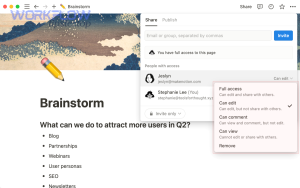
The permission stack (check from top to bottom)
- Account + workspace selection
- Many teams have multiple workspaces; being in the wrong one can look like a lockout.
- Workspace role
- If your role is viewer/guest, you may never get edit rights regardless of page sharing.
- Teamspace membership (if used)
- You might have access to the workspace but not the teamspace where the page lives.
- Page-level sharing
- The page must be shared with you (directly or via group/teamspace) at an edit-capable level.
- Database-level rules
- You may see the database but not specific items if item-level restrictions exist.
Quick fixes to try
- Ask the page owner to re-share the page explicitly to your email and confirm edit permissions.
- Duplicate the page (if allowed) to a location you own, then work there.
- Check “Request access” prompts and include context: what you need to do and when.
Evidence: Notion’s help content organizes troubleshooting around access and account issues (including “I can’t access Notion”), reinforcing that permissions and account state are a core troubleshooting category. (notion.com)
How do you fix Notion sync issues and “missing changes” across devices?
To fix Notion sync issues, use a 5-part approach: confirm you’re online and in the same account/workspace, force a refresh/restart, reset local data if needed, reduce offline edits and conflicts, and verify network restrictions—because “missing changes” usually come from account mismatch, delayed syncing, or stale local cache.

Next, focus on where the missing change is happening (source device vs destination device). That tells you whether you’re dealing with upload, download, or identity mismatch.
A practical sync checklist
1) Confirm identity and location
- Same email/login on both devices?
- Same workspace selected?
2) Force a refresh
- Web: hard refresh.
- Desktop: quit fully and reopen; if necessary, reset local data. (notion.com)
3) Watch for offline/low-connectivity behavior
- If you edited while offline, expect later merges.
- Mobile OS may pause background syncing; open the app and keep it foregrounded briefly.
4) Reduce conflict probability
- Avoid simultaneous edits of the same database row from multiple devices during flaky connectivity.
- Prefer one “source of truth” device when making large structural edits (properties, templates, automations).
5) If a database view looks empty
- Re-check filters/sorts/grouping.
- Check status page for database view incidents. (notion-status.com)
Evidence: Notion’s status logs document incidents that can affect database behavior (including views not displaying items) and often list workarounds—showing that “missing records” can be service-side. (notion-status.com)
When should you contact Notion Support, and what should you send?
You should contact Notion Support when the issue reproduces across devices/networks, persists after a reset, involves account lockout/billing/workspace recovery, or affects multiple users—because these patterns point to service-side, account-level, or policy-level causes you can’t fix locally.
Next, make your support request actionable. The goal is to let support reproduce your issue quickly, not to tell a long story.
What to include (copy-paste checklist)
- Exact symptom (what you see, not what you think it means)
- Timestamp + timezone (when it started, and when you last reproduced it)
- Environment: web/desktop/mobile, OS, browser version
- Network context: office Wi-Fi vs home vs hotspot, VPN on/off
- Repro steps (numbered, minimal)
- Scope: just you vs multiple users vs whole workspace
- Status page check result (link or “no incident”) (notion-status.com)
- What you already tried: hard refresh, reset, reinstall, etc. (notion.com)
What “good” looks like
A good ticket is short, testable, and includes a stable reproduction path like:
“On Chrome, workspace X, database Y → open view Z → table renders empty; occurs on 2 devices and 2 networks; status page shows/doesn’t show incident; started at [time].”
Evidence: Notion’s reset guidance separates desktop vs web reset steps and highlights known-issue tracking via the status page, which are exactly the prerequisites you should complete before escalating. (notion.com)
How do you troubleshoot advanced Notion issues for integrations, enterprise networks, and hard-to-reproduce bugs?
Advanced Notion troubleshooting works best as “observe → isolate → instrument → confirm”: you identify the failing boundary (API vs client vs network vs permissions), capture structured evidence (request/response, timestamps, payload samples), then validate fixes with controlled test cases.
Next, this is where power users and teams win: you stop thinking in vague symptoms and start thinking in interfaces—API calls, webhooks, auth tokens, rate limits, and network policy.
How do you diagnose Notion webhook and API errors (400/401/403/404/429/500)?
Start by classifying the error family, because each implies a different fix path:
- notion webhook 400 bad request → payload shape or headers are wrong; validate JSON and required fields.
- notion webhook 401 unauthorized → missing/invalid auth token; re-check token scope and workspace connection.
- notion webhook 403 forbidden / notion permission denied → token is valid but lacks permission; verify the integration’s access to the database/page.
- notion webhook 404 not found → wrong endpoint or object ID; confirm IDs are from the same workspace.
- notion webhook 429 rate limit / notion api limit exceeded → throttling; add retries with backoff, batch requests, reduce polling frequency.
- notion webhook 500 server error → service-side failure or transient; retry with jitter and check the status page for incidents. (notion-status.com)
Practical instrumentation tips:
- Log request ID, timestamp, endpoint, and response status.
- Save sanitized samples of request/response bodies (no secrets).
- Reproduce with the smallest possible payload.
How do you fix auth/token and payload integrity failures (OAuth, invalid JSON, timezone/data formatting)?
These problems often look random until you control the inputs:
- notion oauth token expired: rotate tokens, reauthorize the integration, and ensure your system clock is correct (time skew breaks token validation).
- notion invalid json payload: validate JSON serialization; watch for trailing commas, wrong encoding, or double-stringified JSON.
- notion timezone mismatch: standardize on UTC internally; convert at edges; store timezone offsets explicitly when you create date properties.
- notion data formatting errors / notion field mapping failed: confirm property types match (date vs text vs select), and map enums exactly.
When you roll out changes, do it with test fixtures:
- One known database with stable schema.
- One page with controlled property values.
- One automated test run that asserts what Notion should store.
How do you prevent data-loss illusions (pagination, duplicates, missing triggers, and backlog/timeout behavior)?
A lot of “Notion lost my data” incidents are actually integration logic:
- notion pagination missing records: implement pagination correctly (cursor-based), and confirm you loop until completion.
- notion duplicate records created: use idempotency keys or “upsert” logic; check existing items before creation.
- notion trigger not firing: verify the trigger’s event scope, permissions, and whether filters exclude the event; add heartbeat logs.
- notion tasks delayed queue backlog / notion timeouts and slow runs: measure queue length, add concurrency controls, and move large batch jobs off peak hours.
A useful pattern is “reconciliation runs”:
- Periodically compare your system-of-record with Notion to detect drift.
- Repair drift with a controlled sync job.
How do you fix content and file edge cases (attachments, empty payloads, and missing fields)?
These are classic “it works for some records but not others” failures:
- notion attachments missing upload failed: validate file size/type rules, ensure the upload URL/token is valid, and retry transient failures.
- notion missing fields empty payload: confirm the integration is requesting the correct fields/properties and handling null/empty values.
- notion field mapping failed: schema drift is common—properties get renamed or changed type; add schema checks before writing.
Evidence: Notion’s official reset workflow (including clearing web cache/cookies and erasing local desktop data) is a baseline step that can remove client-side noise before you debug complex integration failures. (notion.com)