


Connecting Airtable to Miro is the fastest way to turn messy brainstorm output into structured, assignable work—without manually retyping sticky notes into a database. The most reliable approach is to use Airtable’s native Miro Sync or the official Airtable↔Miro integration so ideas on a board become records you can track, prioritize, and ship.
Next, you’ll want to decide why you’re integrating: capturing Miro notes into Airtable for execution, embedding boards inside Airtable for daily collaboration, or using an automation layer to push updates both ways. Those scenarios use different “Airtable to Miro” connection paths and permissions.
Then, you’ll need to confirm prerequisites (accounts, permissions, and what content you’ll sync—stickies, cards, frames, tags, owners) and define the governance rules so your team doesn’t create duplicate records or leak board data into the wrong base.
Introduce a new idea: once the connection works technically, the real win is designing a repeatable workflow—templates, naming rules, and a “single source of truth” policy—so teams can scale the Airtable↔Miro loop without chaos.
What does it mean to connect and sync Airtable to Miro?
Connecting and syncing Airtable to Miro means linking a Miro board (freeform ideas) to an Airtable base (structured records) so selected board content can be captured as organized data your team can track and act on.
To better understand what “Airtable to Miro” really changes day-to-day, separate it into two practical capabilities:
- Capture (Miro → Airtable): Convert stickies/cards/ideas into records you can assign, status, and report on.
- Embed (Miro inside Airtable): Keep visual collaboration close to the database so updates happen where execution happens.
- Automate (Airtable ↔ Miro via iPaaS): Use an automation layer to create/update objects across tools when triggers fire.
In practice, the “sync” wording often hides a key detail: some setups are designed primarily for importing Miro content into Airtable as structured data, while other setups focus on keeping a board visible and usable inside Airtable so teams don’t context-switch.
Evidence: According to a study by the University of California, Irvine from the Department of Informatics, in 2008, participants rated stress higher during interrupted work (9.46–9.13 on a 1–20 scale) than uninterrupted work (6.92), showing why integrations that reduce tool-switching and re-entry overhead can matter in real workflows.
Do you need a native Airtable↔Miro integration or a third-party automation?
Yes—you usually need one or the other, because (1) native integration is simplest to set up and maintain, (2) third-party automation is better for multi-step workflows and pseudo two-way updates, and (3) enterprise teams often need additional governance controls not covered by basic syncing alone.

However, the best choice depends on what your team considers “done”:
- If “done” = ideas become records, start with Airtable’s native Miro connection or sync flow.
- If “done” = board remains the collaboration hub but data stays structured, use embedding + clear record conventions.
- If “done” = work triggers work (create cards, notify, create tasks, update status across multiple tools), use a third-party automation platform.
When is native Airtable↔Miro best?
Native is best when you want a low-maintenance, officially supported path to move Miro content into Airtable and keep the integration understandable for non-technical teammates.
Use native when you:
- Want fast onboarding for the team
- Need predictable behavior with fewer moving parts
- Prefer official support documentation for troubleshooting
When is third-party automation better?
Third-party automation is best when you need multi-step logic (filters, branching, approvals, enrichment, deduping) or when your workflow must touch multiple systems beyond Airtable and Miro.
Choose third-party automation when you:
- Need “if/then” workflows (e.g., only sync approved ideas)
- Want near-real-time routing to other apps
- Need to mimic two-way behavior by combining triggers and updates
What prerequisites should you check before syncing Airtable to Miro?
There are 5 main prerequisites to sync Airtable to Miro—accounts, permissions, data scope, object mapping, and governance rules—because missing any one of them causes the most common setup failures.

Then, check each prerequisite in a “left-to-right” order so you don’t debug the wrong layer.
What accounts and plans do you need?
You need active accounts for both products, and your plan must support the integration method you choose (native integration, sync, or embedding).
- You can log into Airtable and Miro in the same browser session (reduces auth issues)
- Your workspace policies allow connecting external apps/integrations
- Your team’s SSO/security policies won’t block OAuth popups (common in strict browsers)
What permissions do you need in Airtable and Miro?
You need the right permissions because integrations typically require authorization to read/write specific content.
Minimum recommended permissions (typical):
- Airtable: base access where the destination table lives (and permission to create a synced table if using Sync)
- Miro: access to the board(s) you want to pull content from, plus ability to authorize the integration
What data do you want to sync—records, cards, stickies, or attachments?
Define the “unit of sync” before setup, or you’ll end up with records that don’t match how your team works.
Common “Airtable to Miro” mapping choices:
- 1 sticky note = 1 Airtable record (great for ideation capture)
- 1 card = 1 record with fields (owner, status, priority)
- 1 frame/cluster = 1 record representing a theme (useful for research synthesis)
How do you prevent duplicates and messy records?
Decide how you’ll identify uniqueness:
- A “Miro item ID” field (best if available)
- A generated hash (text + board + frame name)
- A strict naming convention (good, but less reliable)
Also decide whether edits happen in Airtable, Miro, or both—because that determines how you handle conflicts later.
How do you set up Airtable to Miro sync step-by-step?
Set up Airtable to Miro sync by following 6 steps—create a destination table, select Miro as the source, authorize access, choose board/content scope, map fields, and validate outputs—so Miro items reliably appear as Airtable records your team can use.
Below, the steps align with the official “Miro sync with Airtable” flow Airtable describes for adding a synced table and selecting Miro.
Step 1: Create a destination table in Airtable
Create a new table (or decide an existing table) that will receive Miro content.
Best practice fields to prepare:
- Idea / Note (long text)
- Source Board (single select or link)
- Cluster / Frame (text)
- Owner (collaborator)
- Status (single select)
- Created date / Imported date (date)
These fields make the incoming Miro items immediately actionable.
Step 2: Choose Miro as the sync source
In Airtable, add/import a table and select the option that corresponds to syncing from Miro.
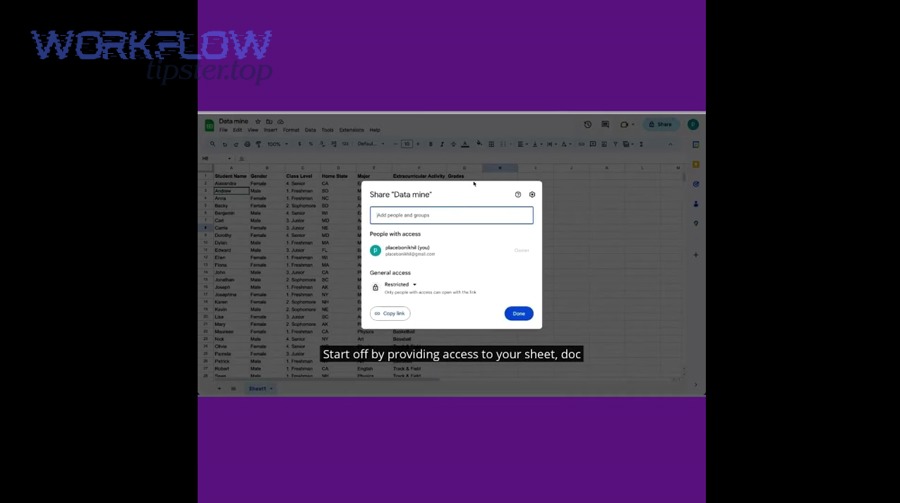
Step 3: Authorize the connection (OAuth)
Authorize Airtable to access your Miro account and the specific boards you plan to sync.
If you get stuck here, the issue is usually:
- Browser blocking popups
- SSO requiring re-authentication
- Workspace admin restrictions on integrations
Step 4: Select the Miro board and content scope
Choose:
- The board to import from
- The object types you want (e.g., stickies/cards)
- Any filtering rules (e.g., only items inside a specific frame)
This is where you “design the funnel” so not every scribble becomes a record.
Step 5: Map fields and normalize your data
Map Miro content into Airtable fields so records are clean and usable:
- Map sticky text → “Idea”
- Map frame name → “Cluster”
- Map author/creator → “Owner” (if available)
- Map tags/colors → “Theme” or “Priority”
Normalization rules to apply immediately:
- Trim whitespace
- Convert emoji-only notes into a labeled format (e.g., “Signal: 🔥”)
- Enforce max length for titles, push full text into long text fields
Step 6: Validate and run a small test import
Run a test with a small board section first.
Verify:
- Items arrive once (no duplication)
- Fields map correctly
- Record formatting is consistent
- The team understands “what happens next” after import
Evidence: According to a study by the University of California, Irvine from the Department of Informatics, in 2008, “time to perform task” in an email-work simulation averaged 22.77 minutes with no interruption versus ~20.31–20.60 minutes under interruption, while stress increased—suggesting people may work faster under fragmentation but pay a cognitive cost, reinforcing the value of reducing unnecessary tool-switching via clean workflows.
What are the best ways to sync Airtable to Miro for real workflows?
There are 4 best ways to sync Airtable to Miro—native integration, Airtable Sync from Miro, embedding boards in Airtable, and third-party automation—based on your criterion of control level, directionality, and operational complexity.
More specifically, “best” changes depending on whether you optimize for speed, governance, or two-way behavior.
Way 1: Native Airtable + Miro integration (fastest setup)
Use the official Airtable + Miro integration when you want a direct connection that aligns with supported requirements and admin controls.
Best for:
- Product ideation → roadmap intake
- Marketing brainstorms → campaign tables
- Research synthesis → insights database
Way 2: Airtable Sync from Miro (Miro → Airtable capture)
Use the sync flow when your goal is to import Miro content into Airtable as a table.
Best for:
- Turning workshop outputs into actionable records
- Keeping Miro as the creative space but Airtable as the execution system
Way 3: Embed Miro boards inside Airtable (collaboration without leaving the base)
Use embedding when your team lives in Airtable but still needs the board visible for context, commenting, and iterative collaboration.
Best for:
- Keeping strategy canvases next to execution tables
- Reducing “where is the latest board?” confusion
Way 4: Third-party “Automation Integrations” for multi-step workflows
Use a platform like Zapier when you need triggers, filters, approvals, and routing beyond a basic sync.
This is also where you can extend into scheduling and coordination flows such as calendly to microsoft teams, google calendar to airtable, or asana to calendly, when the Airtable↔Miro output needs to kick off meetings, timelines, and task orchestration across your stack.
This table contains a practical comparison of the four methods so you can choose based on directionality, setup effort, and best-fit use cases.
| Method | Typical direction | Setup effort | Best for | Key limitation |
|---|---|---|---|---|
| Native Airtable + Miro integration | Often Miro → Airtable capture + aligned workflows | Low | Fast team adoption | Less custom logic than iPaaS |
| Airtable Sync from Miro | Miro → Airtable | Low–Medium | Clean intake pipeline | Not designed for editing back to Miro in Sync mode |
| Embed Miro in Airtable | Visual board inside base | Medium | Context + collaboration in one place | Doesn’t automatically turn everything into structured records |
| iPaaS (e.g., Zapier) | Custom / pseudo two-way | Medium–High | Multi-step workflows | More moving parts to govern |
Is the sync one-way or two-way between Airtable and Miro?
Airtable Sync integrations are one-way by design, while “two-way” behavior typically requires a different integration method (native app behaviors, embedding, or automation flows) to send updates back to the other system.

On the other hand, the phrase “Airtable↔Miro” can be misleading because there are multiple “connections” people mix together:
- Sync integrations (one-way): Sync integrations from external apps into Airtable are one-way, meaning edits in Airtable don’t sync back to the external source.
- Embedding (interactive collaboration, not field sync): You can view/comment/edit a board inside Airtable depending on permissions, but that’s not the same as record-level two-way syncing.
- Automation (pseudo two-way): An iPaaS can watch for changes in Airtable and separately push updates into Miro (and vice versa), creating a “two-way feel” via two one-way automations.
What “one-way” really means in day-to-day work
If you’re using one-way sync from Miro into Airtable:
- Your team should treat Airtable as the execution database
- Miro remains the ideation space
- Updates to records (status, owner, due date) live in Airtable and do not overwrite the original Miro sticky/card automatically
When you actually need “two-way”
You need two-way behavior when:
- Teams edit the same “object” in both tools
- Ownership/status must be reflected visually on the board
- You want a board to always mirror the database view
In that case, skip the assumption that Sync alone will do it—and design an automation architecture that clearly defines which system is authoritative for which fields.
What are the most common issues and fixes for Airtable to Miro syncing?
There are 6 common issues with Airtable to Miro syncing—authorization failures, permission mismatches, wrong board scope, field-mapping errors, duplication, and governance conflicts—and each has a specific fix that prevents repeat breakage.
Next, troubleshoot in a simple order: auth → permissions → scope → mapping → data quality → governance.
Issue 1: OAuth or authorization fails (login loops, blocked popups)
Fix:
- Try a different browser session (or disable strict popup blocking)
- Confirm workspace admin settings allow integrations
- Reconnect the integration after logging into both tools first
Issue 2: “You don’t have access to this board/base”
Fix:
- Confirm you have access to the specific Miro board
- Confirm you’re connecting to the correct Airtable workspace/base
- Ask an admin to enable integration permissions if required
Issue 3: The sync imports the wrong things (too much noise)
Fix:
- Narrow the scope: only items inside a specific frame or tagged items
- Create a dedicated “Export to Airtable” frame in Miro and train the team to place final ideas there
- Use naming conventions for frames (e.g., “✅ Ready for Intake”) to reduce ambiguity

Issue 4: Fields map incorrectly (records are unreadable)
Fix:
- Map the minimum viable fields first (Idea, Cluster, Source board)
- Add enrichment fields later (priority, owner, tags)
- Normalize text (trim, remove repeated whitespace, standardize titles)
Issue 5: Duplicate records appear after multiple runs
Fix:
- Add a “Miro item reference” field (or a unique key field) and dedupe against it
- Avoid running multiple competing syncs into the same table
- If using automation, add an “upsert” rule: update if key exists; create only if missing
Issue 6: Team conflict about where to update (Miro vs Airtable)
Fix:
- Publish a simple authority policy:
- “Ideas live in Miro”
- “Execution fields live in Airtable”
- “If it’s a status/owner/date, Airtable wins”
- Add a record link back to the board location so context stays accessible
Evidence: According to a study by the University of California, Irvine from the Department of Informatics, in 2008, stress scores increased from 6.92 (no interruption) to 9.46–9.13 (interruption conditions) on a 1–20 scale—an argument for workflow design that reduces needless switching, duplicate work, and reorientation friction.
Contextual border: At this point, you can successfully connect Airtable to Miro and keep records clean; next, we’ll shift from “how to set it up” to “how to scale it safely” with enterprise governance, security, and durable operating rules.
How can teams scale Airtable↔Miro workflows for enterprise governance and security?
Teams can scale Airtable↔Miro workflows by using 5 governance steps—standardize templates, enforce permissions, centralize integration ownership, monitor data pathways, and document field authority—so integrations remain secure, auditable, and consistent across departments.
To begin, treat Airtable↔Miro as a system, not a one-off connection.
How do you standardize templates and naming for repeatability?
Create:
- A “Workshop to Records” Miro template (frames: Parking Lot → Themes → Ready for Intake)
- An Airtable intake table template (fields, views, automations, dedupe rules)
- A shared naming convention (Board: Team_Project_Date; Frame: ✅ Ready for Intake)
This reduces variance across teams and makes troubleshooting predictable.
How do you manage permissions and data boundaries?
Apply the principle: least privilege.
- Restrict who can create new syncs or change mapping
- Use workspace-level admin controls for integrations when available
- In embedding scenarios, set board visibility intentionally (view/comment/private) so sensitive boards don’t become casually accessible inside bases
How do you decide “system of record” for fields?
Write a simple field authority matrix:
- Text idea content: Miro-origin
- Owner/status/due date: Airtable-origin
- Priority: Airtable-origin (but optionally mirrored to Miro via labels if using automation)
- Links/files: Airtable attachments (or a governed file system)
Then enforce it with:
- Views that hide non-authoritative fields from casual editors
- Automation rules that reject or flag conflicts (especially if using iPaaS)
How do you monitor and control automations over time?
If you use Automation Integrations, appoint an “integration owner” per workspace:
- Reviews new automations monthly
- Removes abandoned flows
- Maintains a change log (what changed, who changed it, why)
This keeps “shadow automations” from silently duplicating records or leaking data.
How do you expand beyond Airtable↔Miro without breaking governance?
When you extend workflows into scheduling and orchestration—like google calendar to airtable, calendly to microsoft teams, or asana to calendly—treat those as downstream actions triggered only after an idea is approved (e.g., status becomes “Ready”). That prevents early-stage brainstorm noise from creating meetings, tasks, and notifications prematurely.