


Integrating Dropbox Sign (formerly HelloSign) with Microsoft Teams means you can push signing-status updates into the right channels or chats—so admins and operations teams see progress, unblock bottlenecks, and reduce “chasing” without living inside the eSignature dashboard.
Next, you’ll learn what the integration actually includes (and what it doesn’t), how to avoid the common confusion between Dropbox (file storage) and Dropbox Sign (eSignature), and which real-world workflows benefit most from Teams-based notifications.
Then, we’ll walk through what you need before connecting the apps—permissions, governance decisions, and security guardrails—so you can deploy the integration in a way that respects privacy and keeps stakeholders informed.
Introduce a new idea: below is a practical, admin-friendly setup guide that moves from definition → prerequisites → step-by-step configuration → trigger strategy → testing, and finally into advanced governance after the contextual border.
What is the Dropbox Sign (HelloSign) + Microsoft Teams integration, and what problems does it solve?
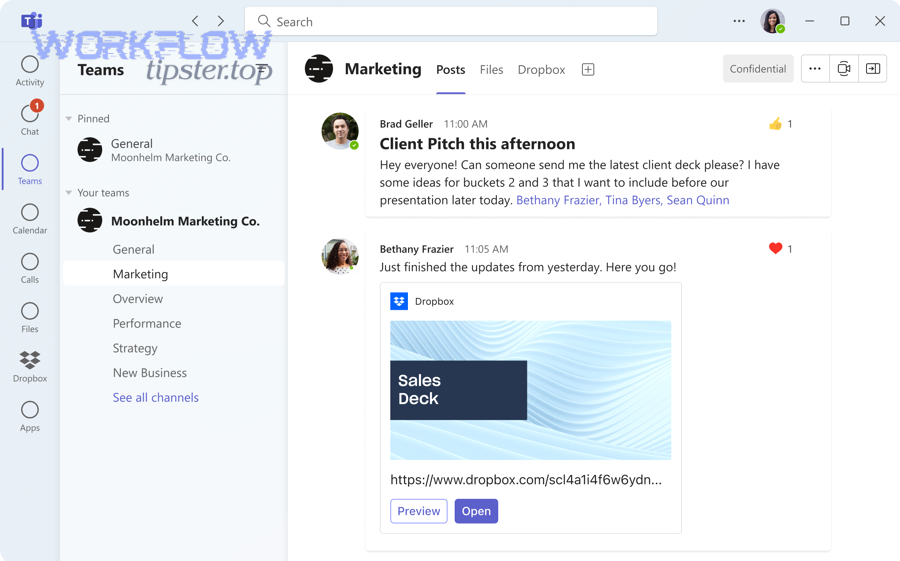
Dropbox Sign (HelloSign) + Microsoft Teams integration is a workflow connection that sends Dropbox Sign eSignature events (like “sent,” “viewed,” “completed,” or “declined”) into Teams channels or chats so your team can act faster, with fewer status-checks and fewer missed handoffs.
To better understand why that matters, it helps to separate what Teams does best (collaboration and rapid decision-making) from what Dropbox Sign does best (signature lifecycle tracking) and then connect them with consistent, actionable notifications.
At a macro level, this integration solves four recurring operational problems:
- Visibility gaps: People don’t know a document’s status until someone asks.
- Slow escalations: A decline or delay sits unnoticed in an inbox.
- Context switching: Teams and ops bounce between chat, email, and signature dashboards.
- Inconsistent governance: Status updates happen informally, making auditing and process improvements difficult.
In practice, the integration usually works in one of two patterns:
- Event-to-message (most common): Dropbox Sign events trigger a Teams message.
- Workflow-to-request (less common): A Teams action (or another app) triggers a signature request, then status updates flow back into Teams.
Because Teams is where decisions get made, the goal is not “more messages.” The goal is fewer blockers—messages that arrive at the right time, to the right place, with the right amount of data.
Is Dropbox Sign the same as HelloSign?
Yes—Dropbox Sign is the current product name, and HelloSign is the legacy name many connectors, guides, and admin settings still reference, which is why you’ll often see “Dropbox Sign (formerly HelloSign)” in integration listings and documentation.
Next, once you recognize this synonym relationship, you can search more effectively for connectors, triggers, and permissions without missing results that still use the older label.
Operationally, the naming matters because:
- Some automation tools list the app as Dropbox Sign, while older workflows or templates still say HelloSign.
- Troubleshooting often requires matching the connector name you used (Dropbox Sign vs HelloSign) with the same label inside the automation platform.
- Admin documentation and support articles sometimes include both names.
Does Microsoft Teams have a native Dropbox Sign integration, or do you need an automation tool?
You usually need an automation tool for event-based notifications, because “native” Teams apps often focus on file collaboration and app access rather than deep eSignature event triggers and routing logic.
Then, the practical decision becomes whether your organization should connect through a no-code automation platform (fast deployment) or a more enterprise-governed approach (central controls, logging, and policy alignment).
Think of it as two layers:
- Native/Direct app experiences: Helpful for surfacing an app inside Teams, but not always designed for “when X happens in Dropbox Sign, post Y to Teams.”
- Automation connectors (Zapier/Make/Power Automate/airSlate/Pabbly, etc.): Designed specifically for triggers, actions, filters, and routing.
A strong admin mindset here is: choose the method that matches your governance model, not just the quickest setup.
What are the most common use cases for admins and operations teams?
There are 4 main use-case groups for Dropbox Sign → Teams notifications: (1) approvals and accountability, (2) revenue workflows, (3) people operations, and (4) compliance visibility—based on which stakeholder needs to act when a signing state changes.
Below, each group shows how the same trigger can create very different value depending on who receives it.
- Approvals & accountability (Ops/Admin):
- Notify a “Contracts Intake” channel when a signature request is sent.
- Notify an “Escalations” channel when a request is declined or expires.
- Summarize daily “completed” docs for reconciliation.
- Sales workflows (Revenue teams):
- Post to the deal channel when the customer views the agreement.
- Alert the account executive when the final signer completes.
- Trigger a handoff to onboarding after completion.
- HR & onboarding (People ops):
- Track offer letters and policy acknowledgements.
- Notify HR shared channels when a candidate signs.
- Escalate if a candidate hasn’t viewed within 24–48 hours.
- Legal & compliance (Risk control):
- Route high-risk templates (NDAs, MSAs) to a legal channel.
- Log status updates for audit-friendly timelines.
- Reduce shadow approvals by centralizing updates.
What do you need before connecting Dropbox Sign to Microsoft Teams?
You need 3 categories of readiness before you connect Dropbox Sign to Microsoft Teams: (1) account and permission access, (2) destination planning inside Teams, and (3) governance decisions about what data can be posted—based on your organization’s security and compliance requirements.
To begin, treat this step like an admin deployment checklist: if you skip it, the integration may “work,” but it won’t be safe, reliable, or scalable.
Which permissions and roles are required in Dropbox Sign and in Microsoft Teams?
You typically need (a) sufficient rights in Dropbox Sign to access the team, templates, or signature requests that generate events, and (b) permission in Microsoft Teams to post into the chosen channel/chat (and sometimes to install or approve the connector/app).
Next, aligning roles early prevents the classic failure mode: the integration is created under one user’s credentials, then breaks when that user leaves or loses access.
A practical admin-oriented breakdown:
- Dropbox Sign side
- Ability to connect the Dropbox Sign account to the automation tool.
- Access to the correct team/workspace and the signature requests you want to monitor.
- If using templates, access to the relevant templates used by the org.
- Microsoft Teams side
- Permission to post messages to specific channels (and access to those teams).
- If your tenant restricts third-party apps/connectors, you may need admin approval to install/use them.
- If you’re using a bot/connector identity, it may require explicit consent or policy allowance.
Evidence you can anchor to: Microsoft’s guidance on Teams app permissions and consent management explains that organizations can configure user consent and manage app permissions to control risk (learn.microsoft.com).
What data should you decide upfront for governance and compliance?
You should decide 5 data rules upfront: which events, which destinations, which fields, who can see them, and how long messages should remain visible—based on your privacy posture and operational needs.
Then, once those rules are explicit, your integration becomes a governance tool rather than an uncontrolled notification stream.
- Events to post
- High-signal: completed / fully executed, declined, expired, canceled.
- Medium-signal: sent, reminder sent.
- Potentially noisy: viewed (use carefully).
- Destinations
- Public channel vs private channel vs private group chat vs direct message.
- Dedicated “doc-status” channel to avoid polluting general channels.
- Fields to include
- Safe basics: document name, status, timestamp, internal request ID, link (if access-controlled).
- Sensitive fields: signer email/phone, personal addresses, attachments.
- Audience
- Map audiences to need-to-know: sales deals to deal channels, HR docs to HR private channels, legal docs to legal channels.
- Retention & audit
- Decide whether Teams is “just alerts” or part of your audit narrative.
- If regulated, consider whether you need structured logging elsewhere in addition to Teams.
Is it safe to post signing updates into Teams (PII and confidentiality)?
Yes, it can be safe to post signing updates into Teams if you apply at least three safeguards: (1) post only minimal, non-sensitive fields, (2) restrict notifications to private channels with proper membership controls, and (3) use access-controlled links rather than attachments.
However, because Teams is collaborative by design, the safer approach is to treat every message as potentially forwardable—so you design messages that remain safe even if seen out of context.
- Use a private channel for HR/legal documents.
- Avoid embedding signers’ personal data; refer to internal IDs or role labels.
- Link to the document inside Dropbox Sign (or your system of record) where permissions are enforced, instead of posting the PDF.
- Limit @mentions—tag only the responsible role, not broad groups.
When admins do this well, Teams becomes the “action layer,” while Dropbox Sign remains the “system of record” for signature artifacts and audit trails.
How do you integrate Dropbox Sign with Microsoft Teams step-by-step using no-code automation?
The fastest no-code method is to connect Dropbox Sign to a workflow automation tool, choose a Dropbox Sign trigger, add a Microsoft Teams message action, map the key fields, and test end-to-end—typically in 6–8 practical steps that produce reliable Teams notifications.
Then, once the base workflow works, you add filters, routing rules, and deduplication so your channels stay useful rather than noisy.
- Choose your integration tool based on governance, budget, and complexity.
- Create a dedicated service identity (or a shared admin-owned connector account) to avoid “single user dependency.”
- Connect Dropbox Sign with the correct team/workspace access.
- Select a trigger (e.g., signature request completed).
- Connect Microsoft Teams and choose the destination (team + channel, or chat).
- Compose a message template with minimal, actionable fields.
- Add filters (only specific templates, only specific requesters, only final completion, etc.).
- Test using real scenarios (multi-signer, decline, expiry, resend).
- Enable and monitor with error handling and change logs.
If your content operation also publishes how-to guides across tools, you can cross-reference these workflows under your “Automation Integrations” hub without repeating the same setup logic for every app pair.
Which integration method should you choose: Zapier vs Make vs Power Automate vs airSlate?
Zapier wins for fastest deployment and broad app coverage, Make is best for visual routing and complex scenarios, Power Automate is optimal when Microsoft tenant governance and DLP are the top priority, and airSlate fits organizations that want document-centric workflow orchestration beyond simple notifications.
Next, the best choice becomes obvious once you rank your criteria: speed, governance, complexity, cost model, and auditability.
- If you need it running today: choose a platform optimized for quick “trigger → action” builds.
- If you need multi-branch logic and data transformations: choose a platform with routers, iterators, and structured mapping.
- If your Microsoft tenant is locked down: choose a platform aligned with Microsoft admin governance and consent workflows.
- If your process is “document workflow first”: choose a workflow suite that centers documents, approvals, and records.
This table contains a quick comparison of method-fit so admins can decide based on governance and complexity, not hype.
| Method | Best For | Typical Strength | Typical Tradeoff |
|---|---|---|---|
| Fast no-code connector | Small-to-mid teams, quick wins | Speed to value | Less centralized governance |
| Visual scenario builder | Complex routing and transformations | Fine-grained control | More setup thinking required |
| Microsoft-native automation | Enterprises with strict tenant policies | Governance + DLP alignment | Connector availability may vary |
| Document-workflow platform | End-to-end doc processes | Workflow orchestration | More “platform” than “simple integration” |
How do you set up the trigger (Dropbox Sign) correctly?
To set up the trigger correctly, you select the exact Dropbox Sign event you care about (such as “signature request sent,” “viewed,” or “declined”), ensure it applies to the right environment (test vs live), and confirm your account plan and permissions allow those events to fire.
Specifically, choosing the wrong trigger is the #1 cause of “nothing happens” troubleshooting later—so it’s worth being precise now.
- Signature Request Completed / Fully Executed: best for handoffs and “done” alerts.
- Signature Request Declined: best for escalations and rapid recovery.
- Signature Request Expired: best for ops follow-up and compliance tracking.
- Signature Request Sent: helpful for visibility, but can be noisy without filters.
- Signature Request Viewed: useful in sales, but often high volume.
Important operational nuance: some platforms differentiate between test_mode and live signing events, and some triggers may require specific plan levels for live events.
Evidence you can anchor to: some major connector listings note that certain Dropbox Sign triggers require a paid API plan for non-test_mode requests (zapier.com).
How do you configure the Teams action (post to channel vs DM vs adaptive card)?
Posting to a channel wins for shared visibility, sending a DM is best for privacy and accountability, and using a structured card is optimal when you want consistent fields and faster scanning—so the right choice depends on your audience and the sensitivity of the document.
However, once you decide the destination style, you can standardize your message template so the workflow remains predictable and audit-friendly.
- Channel message
- Pros: shared context, team-based action, good for operations and sales channels.
- Cons: risk of oversharing if the channel is broad; can cause “channel noise.”
- Direct message
- Pros: privacy, clear ownership, faster response when a single person must act.
- Cons: less shared visibility; hard to onboard replacements.
- Structured card (where supported)
- Pros: consistent formatting, easier scanning, fewer long paragraphs.
- Cons: may require more setup, and capabilities differ by connector.
Tip for admins: if your Teams culture already uses dedicated deal channels or case channels, channel messages will feel natural; if not, start with private ops channels to keep noise under control.
What fields should you map in the Teams message for clarity and minimal risk?
There are 6 safe, high-clarity fields to map: document name, status, requester/owner (internal), timestamp, signer count, and a permission-controlled link—based on the principle that Teams messages should prompt action without exposing sensitive signer data.
Next, once these fields are consistent, your notifications become scannable, searchable, and useful for process improvement.
- Document: {template/document name}
- Status: {sent / viewed / completed / declined / expired}
- Owner: {internal requester or team alias}
- When: {timestamp with timezone}
- Signers: {X of Y completed}
- Link: {URL to the request in Dropbox Sign or internal CRM}
Avoid including:
- Signer personal addresses, phone numbers, or IDs.
- Full document text or attachments inside Teams.
- Public links unless your policy explicitly allows it.
This is also where you can insert cross-ecosystem examples sparingly—for instance, if your team already runs workflows like basecamp to google slides or google forms to pipedrive, you can mirror the same notification style: brief, actionable, and privacy-safe.
Which Dropbox Sign triggers and Teams notifications are best for different workflows?
There are 4 best-practice trigger strategies for Dropbox Sign → Teams notifications—completion-first, exception-first, stage-based, and stakeholder-routed—based on how much signal you want versus how much noise your channels can tolerate.
More specifically, the “best” trigger is the one that changes behavior: it reaches the person who can remove the blocker at the moment the blocker appears.
- Completion-first (minimal noise)
- Only post when fully executed (and optionally when declined/expired).
- Best for: leadership visibility, clean channels, low distraction.
- Exception-first (ops-driven)
- Post only when something goes wrong: declined, expired, canceled.
- Best for: ops teams who handle escalations and recovery.
- Stage-based (balanced)
- Post at key moments: sent → completed, plus exceptions.
- Best for: sales ops, onboarding, teams that want a basic timeline.
- Stakeholder-routed (advanced)
- Route based on template type, requester team, or risk classification.
- Best for: mid-to-large orgs with multiple departments sharing one signing system.
Which triggers should you use for “contract completed” vs “signer viewed” scenarios?
Completed wins for operational certainty, viewed is best for sales momentum signals, and declined is the most urgent exception trigger—so use “viewed” only when it leads to a concrete follow-up action.
However, because “viewed” can generate frequent alerts, you typically protect channels by sending viewed alerts to DMs or dedicated deal channels instead of broad operational channels.
- Use completed/fully executed when a downstream system must proceed and you want clean reporting.
- Use viewed when timing matters and a follow-up action happens immediately.
- Use declined when you need instant escalation due to terms, pricing, or policy issues.
How can you route alerts to the right Teams channel automatically (sales/legal/HR)?
You route alerts automatically by filtering and branching on at least one clear criterion—template type, requester team, document category, or risk level—so each notification lands in the channel that owns the next action.
Then, once routing is in place, Teams becomes an organized operations layer rather than a mixed stream of unrelated alerts.
- Template-based routing
- NDA templates → #legal-contracts
- Offer letters → #hr-onboarding
- Sales agreements → deal channels or #sales-ops
- Requester-based routing
- If the requester is in Sales → sales channel
- If requester is in HR → HR channel
- Risk-based routing
- High-value contracts → legal review channel + executive visibility
- Low-risk acknowledgements → HR or ops channel only
Implementation notes (tool-agnostic): add a filter after the trigger, use branching paths for routing, and standardize channel names so rules are easy to maintain.
Should you notify on every signer step or only on final execution?
Final execution is optimal for low-noise operations, while step-by-step notifications are best when the process is time-critical or multi-stakeholder and delays are costly—so most admins start with final + exceptions, then add step alerts only for high-value workflows.
Meanwhile, you can preserve visibility without flooding channels by switching step alerts to DMs or summaries.
- Channel alerts: final execution + declined/expired
- DM alerts: viewed + “waiting on signer” (owners only)
- Daily summary: open requests older than X days (optional)
Evidence: EDUCAUSE reports that many institutions can shave up to three days from financial agreement processing time by using an e-signature application (er.educause.edu).
How do you test, troubleshoot, and maintain the integration over time?
You maintain a reliable Dropbox Sign → Teams integration by running a structured test plan, monitoring failures with logs and alerts, and standardizing ownership (service account, documented workflow, and change control), which prevents silent breakage when people or permissions change.
In addition, testing is where admins protect Teams from becoming “notification clutter” by validating message quality and routing before rolling out widely.

What should you test before going live (message format, links, permissions)?
There are 7 essentials to test before go-live: trigger accuracy, channel permissions, link access, message clarity, multi-signer behavior, exception handling, and timezone consistency—because any one failure can make alerts misleading or unusable.
Next, once these pass, you can roll out with confidence and reduce support tickets.
- Trigger fires for real documents and matches test_mode vs live expectations.
- Correct team/channel selected and message lands in the intended destination.
- Permissions are correct and recipients can access linked requests when allowed.
- Message template is readable and status is instantly visible.
- Multi-signer scenarios behave correctly for sequential and parallel signing.
- Exceptions (decline/expiry) produce correct escalation messages.
- Time and audit clarity includes timezone labels and consistent timestamps.
Why are Dropbox Sign events not firing, and how do you fix it?
Dropbox Sign events usually fail to fire because the trigger is mis-scoped (wrong environment or template), authentication has expired, required plan/features aren’t enabled, or the connector lacks permission to access the correct team/workspace—so you fix it by checking scope, auth, and eligibility in that order.
Then, once the trigger is firing reliably, you validate that the Teams posting step succeeds and isn’t blocked by Teams app policies.
- Scope check: confirm the correct trigger and correct Dropbox Sign team/workspace.
- Environment check: verify test_mode vs live behavior matches the trigger’s expectations.
- Auth check: reconnect Dropbox Sign and Teams; verify tokens and permissions.
- Plan/feature check: confirm trigger eligibility for live events when required.
- Teams policy check: confirm the tenant allows the connector/app to post messages.
Evidence: some major connector listings note that certain Dropbox Sign triggers require a paid API plan for non-test_mode requests (zapier.com).
How do you handle errors, duplicates, and notification spam?
You handle errors and spam by using three controls: (1) deduplication keys (one status change = one message), (2) filters and throttling (only high-signal events), and (3) fallback alerting (notify an admin channel only when failures occur).
More importantly, this approach keeps Teams usable—because once people start ignoring alerts, the integration stops delivering value.
- Dedupe by request ID + status: suppress duplicate status posts.
- Post only on status change: avoid repeated detections of the same state.
- Delay + recheck: if “viewed” is noisy, delay and post only if it still matters.
- Channel vs DM separation: keep broad channels for final + exceptions, send early signals to owners.
- Integration health channel: route failures to a private admin channel for fast fixes.
Reliability patterns include assigning an owner (role, not person), documenting the workflow, and storing the playbook alongside other operational resources such as WorkflowTipster.top.
Contextual Border: The core setup above answers the primary intent—how to integrate Dropbox Sign (HelloSign) with Microsoft Teams and configure triggers and notifications. Next, we expand into advanced governance, edge cases, and semantic distinctions that help admins scale the integration safely across departments.
What advanced governance, compliance, and edge cases should admins consider for Dropbox Sign → Teams notifications?
Admins should prioritize advanced governance in 4 areas—consent control, least-privilege access, message privacy design, and platform selection—because these decide whether the integration remains secure and compliant as usage grows across HR, legal, and revenue teams.
Besides, advanced guardrails are what separate a one-off automation from an enterprise-ready operating standard.
How do you enforce least-privilege access and admin consent for connectors?
You enforce least-privilege by restricting who can install or consent to apps/connectors, using admin consent workflows where required, and granting only the minimum permissions needed for posting Teams messages and reading relevant Dropbox Sign events.
Then, once you centralize consent, you reduce the risk of “shadow integrations” created by individual users with inconsistent settings.
- Tenant-level consent policy: allow users to consent only to low-risk permissions; require admin approval for higher-risk scopes.
- Admin consent workflow: route app requests for review and approval.
- Service identity strategy: use an admin-owned integration identity rather than personal accounts.
Evidence: Microsoft’s documentation describes how organizations can manage consent and app permissions, including admin consent workflows for apps that require elevated permissions (learn.microsoft.com).
What’s the difference between “Dropbox in Teams” (files) and “Dropbox Sign in Teams” (eSignature events)?
Dropbox in Teams is primarily about file access and collaboration, while Dropbox Sign in Teams is about signature lifecycle events and agreement status—so the first is “storage collaboration,” and the second is “transactional document execution.”
In other words, confusing these two leads to the wrong implementation: you might successfully add Dropbox files to Teams but still have zero signing-status visibility.
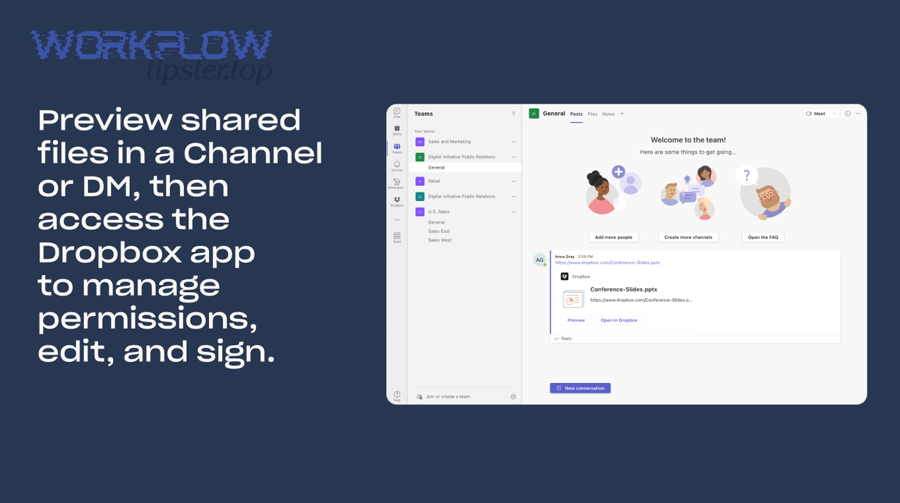
- Dropbox (files) in Teams: share, browse, and collaborate on stored files; improve file access and sharing inside Teams.
- Dropbox Sign (eSignature) → Teams: notify and route actions when signing status changes; speed approvals and clarify ownership.
How do you design Teams notification templates that are audit-friendly but privacy-safe?
Audit-friendly and privacy-safe templates balance three criteria: traceability (IDs, timestamps), minimal disclosure (no PII), and controlled access (links behind permissions)—so you can prove what happened without leaking sensitive signer details into chat.
However, the best templates also reduce operational confusion by making “what to do next” explicit.
- Header: Agreement status update
- Traceability: request ID + template name + timestamp
- Status: completed/declined/expired
- Owner: internal role or requester
- Next action: clear instruction for decline/expiry and handoff steps
- Link: permission-controlled URL
Avoid attaching PDFs to messages, including signer personal information, or posting into broad channels.
Evidence: Dropbox Sign describes its product as an eSignature solution and references its former name HelloSign in official product and integrations materials (sign.dropbox.com).
When should you use Power Automate (Microsoft ecosystem) instead of Zapier/Make?
Use Power Automate when Microsoft tenant governance, DLP policies, centralized admin control, and enterprise compliance workflows matter more than broad third-party connector convenience—while Zapier/Make often fit faster when you need rapid deployment and flexible routing across many non-Microsoft apps.
In short, the “best” choice is the one that matches your IT control plane, not the one with the flashiest templates.
- Choose Microsoft-native automation when you require strict app permission review and centralized logging.
- Choose Microsoft-native automation when you must align automations with existing compliance and DLP controls.
- Choose broad no-code platforms when you need many non-Microsoft integrations and faster iteration.
Decision cues also depend on your existing automation library: if you already run repeatable patterns such as google forms to pipedrive, you may prioritize consistency of build and maintainability across your workflows.