


To integrate Box to Slack, install the Box app in your Slack workspace, sign in to Box, authorize access, and then test sharing a Box file in a channel so your team can collaborate on the same source of truth without breaking file permissions. ([support.box.com](https://support.box.com/hc/en-us/articles/360044195313-Installing-and-Using-the-Box-for-Slack-Integration?))
If you’re deciding whether this is the right approach, the key is whether your team needs governed file sharing (previews, search, and access requests) directly inside Slack—rather than scattering copies across chats, desktops, and email threads. ([support.box.com](https://support.box.com/hc/en-us/articles/360044195313-Installing-and-Using-the-Box-for-Slack-Integration?))
Once the connection works, the next intent is making it safe and predictable: you’ll want to understand how Box permissions behave when a Slack teammate clicks a shared link, and how “request access” flows should be handled so sharing stays fast but controlled. ([support.box.com](https://support.box.com/hc/en-us/articles/360044195313-Installing-and-Using-the-Box-for-Slack-Integration?))
Introduce a new idea: after setup and permission basics, you can level up with notification patterns and lightweight workflow automation—so Box activity can trigger the right Slack updates without creating noisy distractions. ([slack.com](https://slack.com/marketplace/ALQ9XG76D-box?))
Is Box-to-Slack integration the right way to share Box files in Slack for your team?
Yes—Box-to-Slack integration is the right choice for many teams because it keeps files in Box as the system of record, preserves Box permissions while sharing in Slack, and reduces context switching by bringing previews and actions into the conversation. ([support.box.com](https://support.box.com/hc/en-us/articles/360044195313-Installing-and-Using-the-Box-for-Slack-Integration?))
To better understand this decision, start by matching the integration to your team’s collaboration habits, governance needs, and the kinds of files you share most often.

When teams ask “Is Box to Slack worth it?”, they’re usually trying to avoid three common collaboration failures:
- Version sprawl: multiple copies of the same file get shared in different places, and nobody knows which one is current.
- Permission drift: a file intended for a small group gets forwarded broadly, or people waste time requesting access after the fact.
- Context switching: teammates constantly jump out of Slack to search for the right doc, then jump back to explain what they found.
A practical “yes” checklist looks like this:
- Your team already stores core work files in Box (docs, decks, specs, creative assets).
- You want to share files in Slack without uploading duplicates.
- You need predictable access control (and ideally a request-access pathway) rather than ad-hoc forwarding.
- You want teammates to find and reference the same file inside ongoing Slack threads.
Should you use the native Box for Slack app instead of pasting Box links manually?
The native Box for Slack app wins in secure in-channel actions, manual pasting is best for quick one-off sharing, and uploading files directly to Slack is optimal only when you intentionally want a separate copy outside Box governance. ([slack.com](https://slack.com/blog/collaboration/box-and-slack-app-for-improved-content-sharing))
However, the real difference is not “link vs app”—it’s whether Slack becomes a place to access Box content safely, or a place where copies and exceptions quietly accumulate.

Use this comparison when choosing your default workflow:
- Native Box for Slack app: best for teams that want rich previews, file search or pickers, and permission-aware sharing. This approach keeps the file in Box while making it easier to use inside Slack conversations. ([slack.com](https://slack.com/blog/collaboration/box-and-slack-app-for-improved-content-sharing))
- Manual Box link pasting: fine for quick sharing, but it’s more error-prone because teammates may paste the wrong link type (file vs folder, shared link with too-broad access, outdated link), and the experience can be less consistent across channels.
- Upload directly to Slack: useful when you intentionally want a Slack-only artifact, but it can create “shadow copies” that drift away from Box governance and lifecycle.
If you manage content lifecycle seriously—reviews, approvals, retention, or external collaboration—defaulting to the native app usually reduces long-term cleanup work because it minimizes duplicate storage paths.
Do you need admin approval to connect Box to Slack in a workspace?
Yes—many organizations require admin approval to connect Box to Slack because workspace app controls may restrict installations, enterprise policies may govern how third-party apps access content, and Box admins may need to enable the integration before users can complete setup. ([support.box.com](https://support.box.com/hc/en-us/articles/360044195313-Installing-and-Using-the-Box-for-Slack-Integration?))
Next, treat “approval” as a planning step, not a blocker—because the fastest setup is the one that aligns with how your org already manages Slack apps and Box integrations.
In practice, there are three common scenarios:
- Self-serve installs allowed: a team member can install the app from the Slack Marketplace (or Slack App Directory) and authorize Box.
- Slack app installs restricted: a Slack admin must approve or install the app for the workspace, sometimes with additional security review. ([slack.com](https://slack.com/help/articles/360000281563-Manage-apps-in-an-Enterprise-organization?))
- Box integration must be enabled by Box admin: Box enterprise settings may require admin enablement before end users can complete the connection flow. ([support.box.com](https://support.box.com/hc/en-us/articles/360044195313-Installing-and-Using-the-Box-for-Slack-Integration?))
If your team gets stuck at “can’t install” or “cannot authorize,” the fastest fix is to gather a short request package for admins:
- Business reason (what problem you’re solving: secure sharing, fewer duplicates, better collaboration).
- Scope (which Slack workspace(s), which user groups).
- Security expectations (Box remains system of record, permissions remain enforced).
That makes approval easier because it speaks in governance terms rather than “we want another app.”
What is the Box for Slack integration and what does it actually do?
Box for Slack is an integration that connects your Box content repository to your Slack workspace so people can share, preview, and access Box files inside Slack conversations while Box continues to enforce content permissions and controls. ([support.box.com](https://support.box.com/hc/en-us/articles/360044195313-Installing-and-Using-the-Box-for-Slack-Integration?))
Specifically, it turns Slack into a front door for Box content—so teammates can reference the right file at the right time without creating unmanaged copies.

At a macro level, the integration is designed to solve a collaboration paradox: Slack is where decisions happen, but Box is where content lives. When those two are disconnected, teams either waste time hunting for files or they upload duplicates into chats. Box for Slack reduces that gap by making Box content accessible within Slack while keeping Box as the content layer. ([slack.com](https://slack.com/blog/collaboration/box-and-slack-app-for-improved-content-sharing))
What actions can team members perform with Box inside Slack?
There are 4 main types of Box-in-Slack actions: sharing content, previewing and referencing files, searching or picking files, and handling access (like requesting permissions) based on what your workspace and admins allow. ([slack.com](https://slack.com/blog/collaboration/box-and-slack-app-for-improved-content-sharing))
Moreover, thinking in “action groups” prevents confusion—because teams often expect a full file-sync system when the real value is faster, safer access to what’s already in Box.
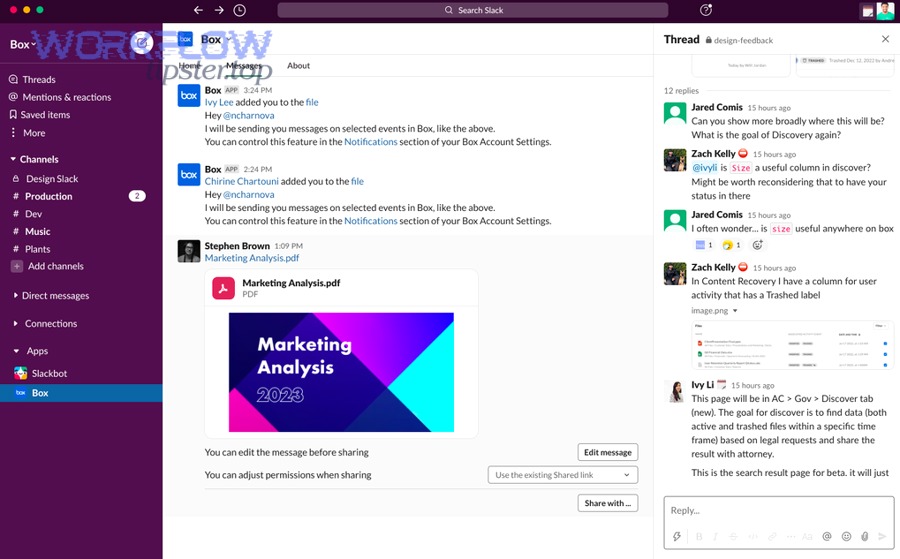
- Share content in-channel: bring a Box file link into a Slack channel or DM with a richer context (name, thumbnail/preview, and more). ([slack.com](https://slack.com/blog/collaboration/box-and-slack-app-for-improved-content-sharing))
- Preview content: view a file card or preview experience inside Slack so teammates understand what the file is before clicking away. ([slack.com](https://slack.com/blog/collaboration/box-and-slack-app-for-improved-content-sharing))
- Search and pick files: locate Box files from within Slack using app features (such as pickers or commands), depending on your configuration. ([support.box.com](https://support.box.com/hc/en-us/articles/360044196033-Box-for-Slack-FAQ?))
- Access workflows: handle “I can’t open this” moments by prompting access requests rather than leaving people stuck or encouraging them to re-upload. ([support.box.com](https://support.box.com/hc/en-us/articles/360044195313-Installing-and-Using-the-Box-for-Slack-Integration?))
If you want to connect this to broader ecosystem thinking, this is exactly why teams invest in Automation Integrations: the goal is not “more tools,” but fewer broken handoffs between where people talk and where work artifacts live.
What’s the difference between “connecting Box to Slack” and “syncing files”?
Connecting Box to Slack wins for permission-aware access and collaboration context, syncing files is best for offline mirroring, and manual exporting/sharing is optimal only for one-time distribution—because Box for Slack is designed to surface Box content in Slack, not duplicate it. ([support.box.com](https://support.box.com/hc/en-us/articles/360044195313-Installing-and-Using-the-Box-for-Slack-Integration?))
On the other hand, many setup frustrations come from expecting “sync behavior” when the integration is really an access-and-sharing layer.
Use this mental model:
- Integration (Box for Slack): Slack becomes a place to reference and act on Box content; Box remains the file system of record.
- Sync: files are copied or mirrored between systems, which introduces duplication, storage questions, and a higher risk of version divergence.
If you want fewer copies and stronger governance, treat Box for Slack as a way to keep files in Box while making them usable in Slack.
What do you need before you connect Box to Slack?
There are 5 main prerequisites to connect Box to Slack: a Slack workspace with app permissions, a Box account with the right access level, admin enablement if required, an authorization step to grant Slack access, and a simple test file to verify sharing and permissions. ([support.box.com](https://support.box.com/hc/en-us/articles/360044195313-Installing-and-Using-the-Box-for-Slack-Integration?))

Then, treat prerequisites as a checklist—because most “it doesn’t work” issues are actually missing permissions, blocked installs, or mismatched accounts.
Here’s a practical pre-flight checklist you can run in under 10 minutes:
- Slack readiness: confirm you can install apps (or know who can). ([slack.com](https://slack.com/help/articles/360000281563-Manage-apps-in-an-Enterprise-organization?))
- Box readiness: confirm you can sign in to the correct Box tenant (work vs personal).
- Admin enablement: confirm whether your Box admin must enable the integration for the org. ([support.box.com](https://support.box.com/hc/en-us/articles/360044195313-Installing-and-Using-the-Box-for-Slack-Integration?))
- Security expectations: understand if shared link policies or external collaboration rules will affect Slack sharing.
- Test artifact: pick a non-sensitive file your team can use to test previews, access, and request flows.
Which accounts and permissions are required for users vs admins?
Users win in day-to-day sharing, Slack admins are best for app installation and workspace policy control, and Box admins are optimal for org-wide enablement and governance—because each role owns a different part of the connection and security chain. ([support.box.com](https://support.box.com/hc/en-us/articles/360044195313-Installing-and-Using-the-Box-for-Slack-Integration?))
Specifically, mapping responsibilities prevents “everyone assumed someone else handled it,” which is the most common cause of stalled rollouts.
Use this role map:
- End users (team members): authorize their Box account, share files, and validate real-world workflows in channels.
- Slack workspace/org admins: approve or install the app, manage app permissions, and enforce workspace-level app governance. ([slack.com](https://slack.com/help/articles/360000281563-Manage-apps-in-an-Enterprise-organization?))
- Box admins: enable the integration, tune controls (like previews and indexing options), and ensure policies align with security requirements. ([support.box.com](https://support.box.com/hc/en-us/articles/360043697294-Deploying-the-Slack-Integration-in-your-Enterprise?))
Practical tip: if your team is small, one person might wear multiple hats. But the responsibilities still matter—because the integration touches both communication and content governance.
Which security settings in Box can block Slack sharing?
There are 4 main Box policy categories that can block or constrain Slack sharing: shared link restrictions, external collaboration rules, permission requirements for previews, and organization-level integration controls that govern how third-party apps access content. ([support.box.com](https://support.box.com/hc/en-us/articles/360043697294-Deploying-the-Slack-Integration-in-your-Enterprise?))
Meanwhile, your goal is not to “turn security off”—it’s to tune policies so sharing stays fast inside Slack while access remains intentional.
What this looks like in practice:
- Shared link rules: if your org restricts who can open shared links, Slack shares may work only for managed users or specific audiences.
- External sharing controls: if guests or external collaborators exist in Slack channels, your Box external-collab policy becomes directly relevant.
- Preview constraints: some admin controls can toggle whether thumbnails/previews are displayed, which affects how “usable” sharing feels. ([slack.com](https://slack.com/blog/collaboration/box-and-slack-app-for-improved-content-sharing))
- Integration governance: enterprise settings may limit which Slack org/workspaces can connect or how content metadata is handled. ([support.box.com](https://support.box.com/hc/en-us/articles/360043697294-Deploying-the-Slack-Integration-in-your-Enterprise?))
If you work in a highly regulated environment, define your “safe defaults” first (who can open links, what kinds of channels are allowed, what happens with external guests), then implement the integration to match those defaults.
How do you connect Box to Slack step-by-step (team setup)?
The simplest way to connect Box to Slack is a 6-step flow—confirm app permissions, install the Box app, sign in to Slack, sign in to Box, grant access authorization, and run a quick share test—so your team can share Box content from the Slack message interface. ([support.box.com](https://support.box.com/hc/en-us/articles/360044195313-Installing-and-Using-the-Box-for-Slack-Integration?))
Below, the focus is to get one successful “happy path” working first, and only then expand to policies, notifications, and automation.

Step-by-step (team-ready, minimal friction):
- Pick a test channel: choose a small internal channel where you can run the first share test.
- Install the Box app: add it to the workspace via Slack’s app directory/marketplace path (or request admin install if needed). ([slack.com](https://slack.com/help/articles/360000281563-Manage-apps-in-an-Enterprise-organization?))
- Sign in to install: follow the install prompt and authenticate with your Slack credentials.
- Authorize Box: log in to Box and approve the requested access so Slack can interact with your Box content through the integration. ([support.box.com](https://support.box.com/hc/en-us/articles/360044195313-Installing-and-Using-the-Box-for-Slack-Integration?))
- Confirm you’re in the right Box account: make sure it’s your work Box tenant, not a personal account.
- Run a share test: share a known file and validate preview + access behavior.
How do you install the Box app in Slack and authorize your Box account?
To install and authorize, open the Box app listing in Slack, choose the install/sign-in path, then log in to Box and approve the authorization prompts—because the integration relies on a consent step that links your Box identity to your Slack workspace. ([support.box.com](https://support.box.com/hc/en-us/articles/360044195313-Installing-and-Using-the-Box-for-Slack-Integration?))
To illustrate the hook chain from setup to outcomes, this is the moment where “we can’t find files” turns into “we can share the right file safely in-channel.”
Make the install smoother with these practical safeguards:
- Use the same browser session where you’re already authenticated to your work Box account, so you avoid accidentally authorizing the wrong tenant.
- Complete the prompts in one sitting so tokens and consent states don’t time out mid-flow.
- If you see a permissions warning, don’t brute-force it—capture the error message and route it to your Slack admin or Box admin with the exact step where it fails.
Evidence: According to official Box Support documentation (Enterprise Integrations guidance), in 2020 the enablement flow includes installing from Slack and then logging in to Box to grant Slack access to Box files as part of the setup process. ([support.box.com](https://support.box.com/hc/en-us/articles/360044195313-Installing-and-Using-the-Box-for-Slack-Integration?))
How can you confirm the integration is working (a 2-minute test)?
You can confirm the Box-to-Slack integration works using a 3-part test: share one Box file in a channel, verify the preview/link card appears, and have a teammate with different permissions click it to validate access or trigger a request flow. ([support.box.com](https://support.box.com/hc/en-us/articles/360044195313-Installing-and-Using-the-Box-for-Slack-Integration?))
More specifically, this test validates the two things that matter most: the sharing experience in Slack and the permission reality in Box.
Run the test like this:
- Share a known file (internal, non-sensitive) in the test channel.
- Check the rendering: do you see a helpful preview context (file name, thumbnail/preview card) rather than a bare URL? ([slack.com](https://slack.com/blog/collaboration/box-and-slack-app-for-improved-content-sharing))
- Permission check: ask one teammate who should have access and one who should not to click the file.
Success looks like this:
- The authorized user opens the file normally in Box.
- The unauthorized user is guided into an access request path rather than getting stuck or encouraging a duplicate upload. ([support.box.com](https://support.box.com/hc/en-us/articles/360044195313-Installing-and-Using-the-Box-for-Slack-Integration?))
If the preview doesn’t appear, don’t assume the integration is “broken.” It often indicates a configuration or policy setting (thumbnails disabled, indexing behavior restricted, or app not fully installed in that workspace). ([slack.com](https://slack.com/blog/collaboration/box-and-slack-app-for-improved-content-sharing))
How do you share Box files in Slack without breaking permissions?
You share Box files in Slack without breaking permissions by keeping the file stored in Box, sharing it through the Box-for-Slack workflow (so recipients must authenticate when needed), and using the “request access” path instead of re-uploading copies when someone lacks permission. ([support.box.com](https://support.box.com/hc/en-us/articles/360044195313-Installing-and-Using-the-Box-for-Slack-Integration?))

Especially in fast-moving channels, the safest sharing habit is the one that makes the correct behavior easier than the risky workaround.
Think of “permission-safe sharing” as three rules your team can follow consistently:
- Rule 1 — Share the Box object, not a copy: reference the Box file/folder so Box remains the authority for access.
- Rule 2 — Let Box handle authentication: don’t downgrade security “just to make Slack sharing easy.”
- Rule 3 — Use access requests deliberately: treat requests as a workflow, not an interruption.
What happens when someone in Slack doesn’t have access to the Box file?
When someone in Slack doesn’t have access, Box remains the enforcement point, the user is prevented from opening the content until permission is granted, and the team should route them through an access request process rather than creating a duplicate file upload. ([support.box.com](https://support.box.com/hc/en-us/articles/360043697294-Deploying-the-Slack-Integration-in-your-Enterprise?))
Then, the important operational step is deciding who should approve access requests and how quickly, so channels don’t turn into bottlenecks.
A good access-request workflow for teams:
- Define owners: identify the file owner or a folder owner group responsible for approvals.
- Define response expectations: e.g., “same business day for internal requests.”
- Define escalation: if a request blocks a deadline, route it to a channel with the owner group tagged.
This is where automation can help without adding complexity. For example, some teams use workflows that notify a “content-owners” channel when a critical folder gets frequent access requests, so governance improves over time instead of staying reactive.
Should you share a Box file, a Box folder, or a shared link in Slack?
A Box file wins for precise collaboration on one artifact, a Box folder is best for ongoing workstreams with multiple assets, and a shared link is optimal for controlled distribution—because each option balances scope, permission clarity, and recipient effort differently. ([support.box.com](https://support.box.com/hc/en-us/articles/360044196033-Box-for-Slack-FAQ?))
However, if your team standardizes on a “default share type” per scenario, you’ll reduce accidental oversharing and speed up collaboration.
Use these scenario-based defaults:
- Share a file when the conversation is about one deliverable (a deck, spec, design file) and you want tight access boundaries.
- Share a folder when the channel maps to a project and multiple files will be referenced over time (briefs, assets, drafts, final exports).
- Share a shared link when you need distribution with guardrails (time-bounded, audience-limited, governed by your org’s link policy).
If you collaborate with external partners in Slack Connect or mixed-access channels, folders often become the cleanest structure—because you can manage access at the folder boundary while keeping the channel conversation focused.
Which notifications and automations can you enable from Box to Slack?
There are 3 main Box-to-Slack notification and automation categories you can enable: Box event notifications (activity updates), workflow-style automations that post to Slack, and structured processes built in Slack Workflow Builder using Box actions—each chosen based on urgency, noise tolerance, and governance needs. ([slack.com](https://slack.com/marketplace/ALQ9XG76D-box?))
In addition, the most effective setups begin with “signal design”: decide what deserves a Slack message, where it should go, and who should be interrupted.
Start with high-value signals:
- A file is ready for review (or updated for review).
- A folder receives a new asset that unblocks work.
- A comment or collaboration invite needs a response.
Then eliminate low-value noise:
- Every minor edit in a high-velocity folder.
- Notifications that go to broad channels when only one owner needs them.
When you build this well, you reduce the “hunt for updates” problem—and you reduce the “too many pings” problem at the same time.
Can Box send file activity notifications to Slack channels or DMs?
Yes—Box can surface event notifications in Slack, and teams typically route them to channels for shared workstreams, to DMs for personal tasks, or to an owner channel for approvals because each destination optimizes visibility, accountability, and noise control differently. ([slack.com](https://slack.com/marketplace/ALQ9XG76D-box?))
Next, choose the destination using a simple rule: if the update changes group work, post to a channel; if it creates a personal action, route it to a DM or an owner queue.
Practical patterns that keep Slack usable:
- Project channel notifications: “New file added to /Project X/Assets” for a team that actively collaborates there.
- Owner queue channel: “Access requested for /Legal/Contracts” routed to a small group responsible for approvals.
- DM notifications: “You were invited to collaborate” sent to the specific user.
If you’re worried about interruptions, aim for fewer, more meaningful notifications—because attention is a limited resource in busy teams.
Should you use native Box notifications or Zapier-style automations for Box → Slack alerts?
Native Box notifications win for simplicity and governance alignment, Zapier-style automations are best for custom multi-step workflows, and Slack Workflow Builder is optimal for structured internal processes—because each approach trades off flexibility, maintenance overhead, and admin control. ([commons.wikimedia.org](https://commons.wikimedia.org/wiki/File%3ASlack_Technologies_Logo.svg?))
Meanwhile, your best choice depends on whether you need a single alert or a full workflow that updates multiple systems.
Use this decision guide:
- Choose native notifications when you want “Box activity → Slack awareness” with minimal configuration and fewer moving parts.
- Choose workflow automations when you need conditional logic (e.g., “If a file is added to Folder A, notify Channel B and create a task elsewhere”). This is where patterns like “airtable to clickup” often appear in broader operations stacks—because teams connect content events to task execution.
- Choose Workflow Builder when you want repeatable internal request flows (forms, approvals, and routing) using Box actions as part of the process. ([commons.wikimedia.org](https://commons.wikimedia.org/wiki/File%3ASlack_Technologies_Logo.svg?))
If you want a fast starting point, pick one workflow that saves time weekly (like “new asset posted” or “approval requested”), ship it, then expand—rather than trying to automate everything at once.
Evidence: According to a study by the University of California, Irvine from the Donald Bren School of Information and Computer Sciences, in 2008 researchers reported measurable disruption costs from interruptions and reorientation time when people switch tasks—supporting the idea that notification design should prioritize signal over noise. ([ics.uci.edu](https://www.ics.uci.edu/~gmark/chi08-mark.pdf?))
What are the most common Box-to-Slack issues and how do you fix them?
There are 5 common Box-to-Slack issues—missing previews, authorization failures, wrong-account logins, “no access” errors, and app installation restrictions—and you fix them by checking app install status, re-authorizing the correct Box account, validating Box permissions, and confirming admin policies for previews and indexing. ([support.box.com](https://support.box.com/hc/en-us/articles/360044195313-Installing-and-Using-the-Box-for-Slack-Integration?))
To begin, troubleshoot by symptom rather than guessing—because each symptom points to a specific layer: Slack app governance, Box authorization, or Box permissions.
Use this quick triage table (it lists the symptom, the likely cause category, and the fastest check):
| Symptom | Likely cause | Fastest check |
|---|---|---|
| Preview card doesn’t appear | Preview/thumbnail settings or app not fully enabled | Confirm app is installed in the workspace and preview settings aren’t disabled |
| “You don’t have access” | Box permissions / wrong account / shared link rules | Verify you’re signed into the correct Box tenant and that the file grants access |
| Can’t install the app | Slack app restrictions | Ask a workspace/org admin to approve/install the app |
| Authorization loop / sign-in repeats | Session/auth mismatch | Log out of personal Box accounts, retry with work account in a clean browser session |
| Sharing works for some channels but not others | Workspace-level app deployment differences | Confirm app is added to all needed workspaces/channels |
Why does the Box preview or file action not appear in Slack?
The Box preview or file action often doesn’t appear because the app isn’t installed or enabled in that workspace, admin settings may disable thumbnails/previews, or the integration cannot surface metadata for that link type—so fixing it means verifying installation and the relevant preview/indexing controls. ([slack.com](https://slack.com/blog/collaboration/box-and-slack-app-for-improved-content-sharing))
Next, validate the most basic condition first: is the Box app actually present and authorized for the user in the workspace where the issue occurs?
Follow this order (fastest to slowest):
- Check workspace app presence: confirm the Box app is installed and available in the workspace where the message was posted.
- Check the link type: verify you shared a Box file/folder link that the integration supports for rich previews.
- Check admin preview controls: if previews are disabled at the admin level, Slack may show only a plain link or limited info. ([slack.com](https://slack.com/blog/collaboration/box-and-slack-app-for-improved-content-sharing))
- Test with a different file: use a simple PDF or doc known to have previews to rule out file-type edge cases.
Once previews work reliably in one test channel, roll out the same settings to other workspaces/channels to keep the experience consistent.
Why does Slack say “You don’t have access” even when you think you do?
Slack shows “You don’t have access” most often because you’re authenticated to the wrong Box account, the file permission is different than expected (file vs folder inheritance), or shared link policies restrict who can open the link—so the fix is to verify identity, then validate permissions at the source. ([support.box.com](https://support.box.com/hc/en-us/articles/360043697294-Deploying-the-Slack-Integration-in-your-Enterprise?))
Moreover, this is the exact moment teams are tempted to “just upload it to Slack,” which solves the immediate access problem but creates a long-term governance problem.
Resolve it systematically:
- Identity check: confirm the user is signed into the correct Box tenant (work account) before testing access again.
- Permission check: confirm the file’s collaborators and the folder’s inherited access match what you assume.
- Policy check: if your org restricts shared links, ensure the link is valid for the intended audience (managed users vs anyone with the link). ([support.box.com](https://support.box.com/hc/en-us/articles/360043697294-Deploying-the-Slack-Integration-in-your-Enterprise?))
- Request-access workflow: if access truly should be granted, route the request to the owner group rather than creating a duplicate copy.
As an analogy for broader stack integration, this is similar to cases like “dropbox sign to onedrive” migrations: the hard part is not moving content—it’s keeping identity, permissions, and lifecycle policies aligned so sharing stays safe.
How can admins secure and scale Box for Slack across an organization?
Admins can secure and scale Box for Slack by using an org-wide rollout plan, setting consistent preview/indexing and access-control policies, and deploying the app across the right Slack workspaces—because enterprise-scale success depends on governance consistency more than individual installs. ([support.box.com](https://support.box.com/hc/en-us/articles/360043697294-Deploying-the-Slack-Integration-in-your-Enterprise?))

Thus, the best admin strategy is to standardize a secure default experience first, then allow controlled flexibility for teams with unique workflows.
What’s the best way to deploy Box for Slack: self-serve installs or admin-managed rollout?
Admin-managed rollout wins for consistency and governance, self-serve installs are best for rapid experimentation, and phased deployment is optimal for large organizations because it balances speed, support load, and policy correctness. ([slack.com](https://slack.com/help/articles/360000281563-Manage-apps-in-an-Enterprise-organization?))
To begin, decide which outcome matters most in your org: fastest adoption, lowest risk, or lowest support burden—then choose the deployment style that matches.
A practical deployment approach for most enterprises is phased rollout:
- Pilot: one department and a few high-usage channels.
- Harden: tune preview/indexing, define request-access owners, document “safe sharing defaults.” ([slack.com](https://slack.com/blog/collaboration/box-and-slack-app-for-improved-content-sharing))
- Scale: add to additional workspaces, train champions, and monitor recurring issues.
Which policy settings should you review to prevent risky sharing in Slack?
There are 4 policy groups to review to prevent risky sharing: preview/thumbnail visibility, Slack search/indexing behavior for shared Box content, shared link audience restrictions, and whitelisting/organization-connection controls where applicable—because these determine what’s visible, searchable, and accessible at scale. ([slack.com](https://slack.com/blog/collaboration/box-and-slack-app-for-improved-content-sharing))
Especially for regulated teams, policy review should focus on “what becomes discoverable” and “who can open what,” not just on whether the app is installed.
Policy review checklist:
- Preview visibility: decide whether thumbnails/previews should display in channels to reduce accidental exposure. ([slack.com](https://slack.com/blog/collaboration/box-and-slack-app-for-improved-content-sharing))
- Indexing/search: decide whether shared Box items should be accessible via Slack search (convenient) or restricted (tighter visibility). ([slack.com](https://slack.com/blog/collaboration/box-and-slack-app-for-improved-content-sharing))
- Shared link governance: ensure link defaults match your internal/external collaboration model.
- Org connection controls: enforce which Slack organizations/workspaces can connect, when relevant. ([slack.com](https://slack.com/blog/collaboration/box-and-slack-app-for-improved-content-sharing))
Can you use Box AI inside Slack, and when does it make sense?
Yes—Box AI can be used in Slack when your organization enables it, and it makes sense when teams need faster answers and summaries from Box files shared in conversations, want to reduce repetitive “where is the info?” questions, and can apply appropriate governance for sensitive content. ([support.box.com](https://support.box.com/hc/en-us/articles/4415585987859-Box-as-the-Content-Layer-for-Slack?))
Next, treat this as a “capability layer” on top of a stable integration—not a replacement for disciplined file structure and permission hygiene.
It’s most valuable in these cases:
- Project channels: teammates can ask consistent questions about the latest doc without each person re-reading the full file.
- Onboarding: new members can quickly understand what a spec or deck says while still relying on the official Box artifact.
- Operational work: teams can extract action items or summaries from shared documents and then route tasks into their execution tools.
If your content includes confidential data, set clear internal rules about what types of files should be discussed in channels, and keep access boundaries tight.
What are the warning signs that your team should NOT use Box-to-Slack (and choose an alternative workflow)?
No—your team should not use Box-to-Slack as the default workflow when you can’t obtain admin approval, your security policies prohibit in-channel previews or indexing, or your Slack environment includes broad external participation that conflicts with Box link governance—because these conditions increase risk and support burden. ([slack.com](https://slack.com/help/articles/360000281563-Manage-apps-in-an-Enterprise-organization?))
In short, these warning signs don’t mean “never integrate”—they mean you should redesign the workflow (or scope it to safer workspaces) before rolling it out broadly.
Common red flags (and safer alternatives):
- No admin pathway: if installs are blocked with no governance exception process, use a documented “Box link sharing standard” and centralize requests until approval is possible.
- Strict visibility rules: if previews/indexing must be off, use tightly controlled channels and focus on folder-based access models rather than broad sharing.
- High external presence: if channels include many external guests, consider separate workspaces/channels for external collaboration with stricter folder policies.
- High confusion tolerance is low: if users frequently sign into the wrong accounts, you may need SSO alignment and training before scaling.
In those cases, your “antonym strategy” is intentional friction: you trade some convenience for clearer access boundaries—and that’s often the correct decision in high-risk environments.