


Integrating Airtable with Freshdesk is the most practical way for support teams to turn structured intake data into actionable tickets, keep ticket updates visible in a shared workspace, and reduce manual copy-paste across tools—without losing the operational rigor a helpdesk requires.
Next, you’ll learn how to decide between one-way automation and true two-way sync, because the “right” direction depends on where your team wants the source of truth to live and how much change control you’re willing to manage.
Then, you’ll get a clear framework for choosing an integration method (fast no-code, flexible workflow automation, or custom API) and the most common automation recipes that actually match real support processes.
Introduce a new idea: once you understand the decision logic and the core workflows, you can build an integration that stays reliable under load—by mapping fields correctly, preventing duplicates, and troubleshooting failures before they impact customers.
What does it mean to integrate Airtable with Freshdesk for ticket automation and two-way sync?
Integrating Airtable with Freshdesk is a support-operations workflow that connects Airtable records (structured data) to Freshdesk tickets (service requests) so you can automatically create, update, and optionally synchronize ticket data in one direction or both.
To better understand this, think of Airtable as the structured “intake and operations layer” and Freshdesk as the “execution and communication layer,” where each system keeps doing what it’s best at—while automation moves the right data at the right time.

In practical terms, “ticket automation” usually means Airtable triggers actions such as:
- Create a Freshdesk ticket when a new Airtable record is submitted (intake → ticket).
- Update a ticket when an Airtable record changes (triage → ticket changes).
- Write back the Freshdesk ticket ID, status, or assignee into Airtable (visibility → operations dashboard).
“Two-way sync” is more specific: it means both sides can update shared fields, and the integration includes rules to prevent conflicts and loops. The moment you allow both systems to write, you’re no longer building a simple automation—you’re building a synchronization system with ownership rules.
According to a study by Ca’ Foscari University of Venice from the Department of Management, in 2023, using hierarchical information in ticket-classification models improved results on a 35,000-issue dataset by up to 5.7% in F-score and 5.4% in accuracy—showing why structured routing and automated processing matter when ticket volumes rise.
Do you need one-way automation or two-way sync between Airtable and Freshdesk?
Yes—most support teams need one-way automation first, because it’s faster to launch, easier to govern, and safer to scale; you should only choose two-way sync if you need shared ownership of updates, real-time visibility, and consistent cross-tool reporting without manual reconciliation.

More importantly, the decision is not “what’s possible,” but “what reduces operational risk while meeting your support outcomes,” because every extra sync direction increases complexity.
Is one-way Airtable → Freshdesk best for creating tickets from structured requests?
Yes, Airtable → Freshdesk is usually best for ticket creation because it standardizes intake, reduces missing fields, and ensures every request becomes a trackable ticket without manual handoffs.
Specifically, this one-way pattern is ideal when Airtable acts as your front door for:
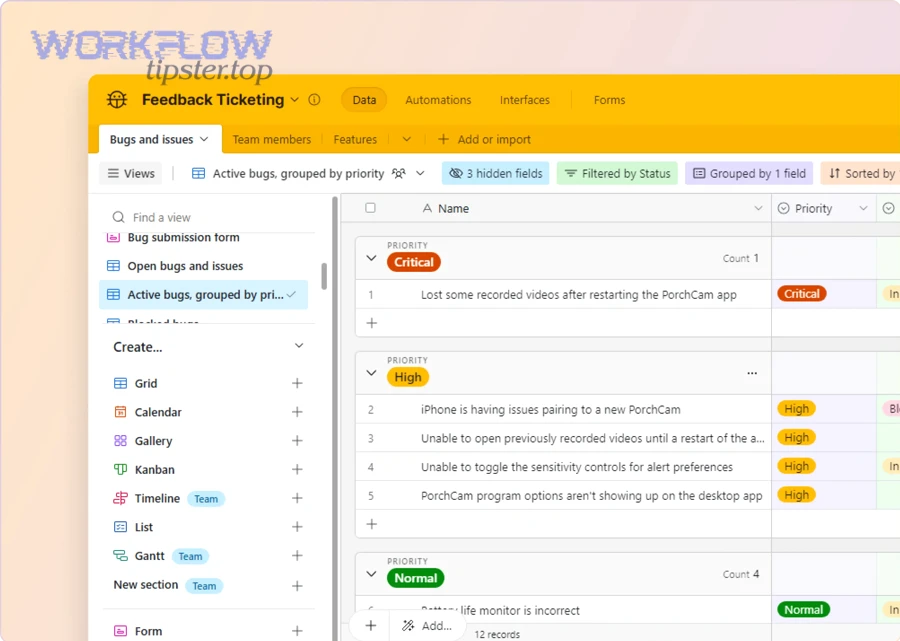
- Product feedback intake (feature requests, bug reports, UI issues).
- Customer success requests (renewal support, onboarding issues, account changes).
- Internal support requests (IT, facilities, procurement intake).
A reliable setup typically includes:
- A dedicated Airtable “Intake” table (one record = one request).
- Required fields (requester email, category, summary, details).
- A “Send to Freshdesk” checkbox or status (so you control when tickets are created).
- A write-back field for the Freshdesk Ticket ID (so Airtable can reference the ticket later).
Is Freshdesk → Airtable best for reporting, trends, and backlog visibility?
Yes, Freshdesk → Airtable is best for reporting and trends because Freshdesk is the system of record for ticket outcomes, while Airtable is often better for custom dashboards, segmentation, and cross-team planning.
For example, you can pull ticket attributes into Airtable to power:
- Weekly volume trends by category and product area.
- Backlog aging by priority tier.
- Time-to-first-response snapshots for internal SLA reviews.
- Customer feedback aggregation tied to product roadmap items.
This is also where support leaders get value: Airtable becomes the “planning and analysis” layer—without forcing agents to work outside the helpdesk.
Is two-way sync worth it if your team needs a single source of truth?
Yes, two-way sync can be worth it if you define field ownership rules, implement loop prevention, and accept the maintenance overhead; otherwise, it tends to create conflicts, duplicate updates, and “who changed this?” confusion.
In practice, two-way sync is worth it when:
- A support ops team manages structured workflows in Airtable (triage, approvals, internal routing).
- Agents need to work in Freshdesk, but managers need real-time operational visibility in Airtable.
- You must keep certain fields aligned (status, priority, assignee, SLA tier) without manual updates.
If you cannot define “source of truth per field,” you should not do two-way sync—because the sync itself becomes the problem.
Which integration method should support teams choose to connect Airtable and Freshdesk?
No-code wins in speed-to-launch, workflow automation platforms are best for complex routing and error handling, and custom API integrations are optimal for security, scale, and strict governance.

However, the best method is the one your team can maintain under real operating conditions—when fields change, categories evolve, and ticket volume spikes.
Before the comparison, the table below contains a practical decision guide showing which integration method fits different support environments (speed, complexity, governance, and scale).
| Method | Best for | Strengths | Trade-offs |
|---|---|---|---|
| No-code connector | Fast launch, common recipes | Simple setup, templates, low engineering effort | Limited branching, weaker observability |
| Workflow automation platform | Multi-step logic, robust error handling | Filters/routers, retries, webhooks, mapping tools | More configuration, higher complexity |
| Custom API integration | Enterprise governance, high volume | Full control, security, idempotency, tailored sync | Engineering required, ongoing maintenance |
In addition, when you’re building Automation Integrations across your stack, choosing a consistent method reduces long-term fragmentation—so your team doesn’t end up with five tools doing the same job in five different ways.
What’s the best no-code option for Airtable ↔ Freshdesk (fast setup, common automations)?
A no-code connector is best when your workflow is straightforward—create or update tickets, write back ticket IDs, and sync a small set of fields with predictable rules.
To illustrate, “Airtable record created → Freshdesk ticket created” is the classic no-code win because it needs:
- One trigger
- One action
- Simple field mapping
- Minimal exception handling
This option is also easiest to document for ops teams and easiest to transfer if your admin changes roles.
When should you use a workflow automation platform for complex logic and branching?
You should use a workflow automation platform when you need branching logic (routing), multi-step actions (create ticket + create contact + add note), or reliable retries and monitoring.
More specifically, workflow platforms help when you must:
- Route tickets based on category + region + customer tier.
- Enrich tickets with data from multiple Airtable tables (accounts, contracts, SLAs).
- Prevent duplicate creation using lookups and conditional logic.
- Implement safe retries (so a temporary API failure doesn’t drop requests).
This is also where cross-tool ecosystems appear—your team may already be doing patterns like airtable to loom (attach recorded reproduction steps) or clickup to outlook calendar (scheduling tasks into calendars). Those are signs your org benefits from a consistent workflow layer rather than one-off automations.
When is a custom API integration the best choice for security and scale?
A custom API integration is best when you need strict access control, high-volume processing, advanced deduplication, or deeper object syncing than typical connectors support.
Especially for scale, custom builds let you:
- Implement idempotency keys to prevent duplicates during retries.
- Enforce field-level ownership (source of truth rules).
- Log every change for audit and compliance.
- Batch and throttle requests to respect API limits and avoid outages.
If your support data touches billing or finance workflows (for example, syncing purchase issues into accounting with patterns similar to google docs to quickbooks), custom governance becomes more valuable—because mistakes are more expensive than engineering time.
What are the most common Airtable → Freshdesk ticket automation workflows?
There are 4 main Airtable → Freshdesk workflow types—ticket creation, ticket updates, requester/contact sync, and routing automation—based on what object you automate and when the automation triggers.

Next, you can use these “recipes” as building blocks, then combine them into a complete support pipeline.
Which workflows create Freshdesk tickets from new Airtable records?
The most common ticket-creation workflows convert an Airtable intake record into a Freshdesk ticket, then store the ticket ID back in Airtable to anchor future updates.
A strong version of this workflow includes:
- Trigger: New Airtable record created OR status changes to “Approved/Ready”
- Action: Create Freshdesk ticket
- Write-back: Save Freshdesk Ticket ID into Airtable
- Optional: Add tags/group assignment based on Airtable fields
Key implementation details that keep it clean:
- Make “requester email” required in Airtable.
- Normalize categories (use a single-select field rather than free text).
- Set default priority rules (e.g., “Outage” = high priority).
According to Freshdesk’s developer documentation, ticket creation is supported via the Helpdesk Tickets API endpoint, including ticket creation with attachments via multipart form data—so your workflow can support screenshots and logs when needed.
Which workflows update ticket fields when Airtable records change?
The second common workflow updates Freshdesk tickets when Airtable triage fields change, such as priority, category, and internal notes.
A practical setup:
- Trigger: Airtable record updated (priority/status/owner changed)
- Condition: Freshdesk Ticket ID exists
- Action: Update Freshdesk ticket fields (or add a note)
This pattern is powerful for structured triage:
- Support ops can manage categorization in Airtable.
- Agents stay in Freshdesk and see the updated fields.
- Managers get consistent taxonomy without forcing agent behavior.
Which workflows create/update contacts or companies from Airtable?
Contact syncing is common when Airtable is the “customer database layer” for support ops, especially if requesters may not exist yet in the helpdesk.
Typical patterns include:
- If contact exists → update contact fields (tier, region, account owner).
- If contact does not exist → create contact, then create ticket.
This prevents tickets from being created with incomplete requester info and makes customer context visible inside Freshdesk where agents need it.
Which workflows use tags, groups, or assignment rules for routing?
Routing workflows apply rules so tickets land with the right team fast—usually via group assignment, tags, or priority settings.
Airtable fields that commonly drive routing:
- Product area (billing / technical / onboarding)
- Customer tier (enterprise / SMB)
- Region or language
- Severity (outage / degraded / request)
A clean routing strategy:
- Use Airtable as the routing decision layer (explicit taxonomy).
- Apply routing changes to Freshdesk (so agents see the outcome immediately).
- Store routing decisions back in Airtable (so ops can audit and improve rules).
How do you map fields correctly between Airtable and Freshdesk without breaking your process?
Field mapping is the controlled translation of Airtable fields into Freshdesk ticket/contact fields (and back), built on data types, required fields, and value normalization so automation stays stable even as your workflow evolves.
Then, once you map the minimum required fields, you can extend into custom fields and advanced formatting without creating brittle integrations.

What is the minimum field mapping to create a valid Freshdesk ticket?
The minimum mapping is: requester identity + subject + description, plus optional defaults for priority and status.
A common minimal mapping set:
- Airtable “Requester Email” → Freshdesk requester email
- Airtable “Summary” → Freshdesk subject
- Airtable “Details” → Freshdesk description
- Airtable “Category” → Freshdesk tags or custom field
- Airtable “Severity” → Freshdesk priority
Operational guardrails:
- Validate required fields before creating tickets (no empty requester).
- Use a predictable subject template (helps dedup and search).
- Store the Freshdesk Ticket ID in Airtable immediately.
How do you map custom fields and dropdown values safely?
You map custom fields safely by using translation tables and controlled vocabularies—so Airtable values always match the acceptable values Freshdesk expects.
Best practices:
- Use Airtable single-select fields for anything that becomes a dropdown in Freshdesk.
- Create a “Mapping” table in Airtable if multiple labels must translate (e.g., “Bug” → “Incident”).
- Avoid free-text for fields that drive routing or reporting.
This also improves reporting quality later—because you remove taxonomy drift (the slow death of support analytics).
How do you handle attachments, rich text, and long descriptions?
You handle attachments and formatting by using links, notes, and structured summaries—because rich text often transforms across systems, and attachments may require special API handling.
Practical patterns:
- Store files in a shared repository and include links in the ticket description.
- Keep an “Agent Summary” field in Airtable that becomes the top of the Freshdesk description.
- Add internal notes rather than overwriting long ticket bodies repeatedly.
Freshdesk’s API documentation notes that creating a ticket with attachment requires multipart/form-data—so if your integration tool cannot send multipart requests, you may need a workaround (links or a different integration method).
How can you prevent duplicate tickets and sync conflicts in Airtable ↔ Freshdesk?
You can prevent duplicates and sync conflicts by using a stable join key (Freshdesk Ticket ID), enforcing idempotent creation rules, and defining source-of-truth ownership per field—because duplicates usually come from retries, unclear triggers, or both systems writing the same fields.

Moreover, once you design for duplicates early, your integration becomes resilient under failure—exactly when automation is most needed.
Should you store the Freshdesk Ticket ID inside Airtable?
Yes, you should store the Freshdesk Ticket ID in Airtable because it becomes the primary reference key, enables safe updates, and prevents “create again” behaviors when a workflow reruns.
A simple schema:
- Airtable field: “Freshdesk Ticket ID” (single line text or number)
- Set it immediately after ticket creation
- Use it as a condition for all future updates
Additional dedup tactics:
- Save a “Ticket Created At” timestamp in Airtable.
- Save an “Integration Run ID” for auditing.
What conflict rules should you define for two-way sync (source of truth)?
You should define 3 conflict-rule groups—Freshdesk-owned fields, Airtable-owned fields, and shared fields—based on who is responsible for the truth of that data.
A common ownership model:
- Freshdesk-owned: ticket status updates, agent replies, resolution notes
- Airtable-owned: internal categorization, roadmap link, internal owner, triage metadata
- Shared (careful): priority, assignee/group, tags
Loop prevention rules that work:
- Use a “Last Updated By Integration” flag or timestamp.
- Only sync changes when the value actually changed.
- For shared fields, prefer a single direction unless there is a clear business reason.
According to Freshdesk API guidance on pagination and filtered ticket listing, ticket operations are paginated and structured—which is helpful for controlled sync—but it also means naive “sync everything every time” designs will quickly become slow and error-prone at scale.
What are the essential setup steps to launch the integration safely?
There are 6 essential setup steps to launch Airtable ↔ Freshdesk safely—define the workflow contract, prepare data and permissions, build and test mapping, implement dedup rules, run a staged rollout, and monitor failures—because reliability is a launch requirement, not a later improvement.
Then, once your checklist is complete, you can expand workflows confidently without re-architecting the foundation.
Which accounts, permissions, and API credentials do you need?
You need a dedicated integration identity with least-privilege access, plus stable credentials and clear ownership of who can modify the automation.
Key requirements:
- Airtable: access to specific bases/tables used for integration
- Freshdesk: API access under an admin-approved integration account
- Documentation: who owns the integration and who can change mappings
Security best practices:
- Do not embed personal tokens in shared scripts.
- Rotate keys on a schedule (and after staff changes).
- Log which workflows are enabled and what they touch (tables/fields).
How do you test the integration before going live?
You test safely by using a staging base and a staging helpdesk environment (or isolated tags/queues), running controlled test cases, and validating every mapped field and expected outcome.
A testing sequence that prevents surprises:
- Create test Airtable records for each category and severity
- Confirm ticket creation, tagging, and assignment
- Confirm write-back of ticket ID into Airtable
- Update Airtable record fields and confirm ticket updates
- Trigger retry/failure simulations (e.g., missing requester email)
- Validate that no duplicates occur when rerun

How do you monitor and maintain the automation after launch?
You maintain automation by monitoring failures, tracking volume and latency, documenting changes, and reviewing mapping quarterly—because ticket workflows evolve and integrations break most often during “small changes.”
Operational monitoring checklist:
- Failure alerts for failed runs (email/Slack)
- A “dead-letter queue” approach (store failed records to retry)
- Weekly review of new categories/fields
- A change log: what changed, why, and when
If your integration method supports it, add run logs that show:
- Trigger record ID
- Action (create/update)
- Freshdesk Ticket ID
- Timestamp
- Error details
What are the most common integration problems and how do you fix them?
There are 3 main integration problem categories—creation failures, sync failures/loops, and scale/API limit failures—based on where the workflow breaks (data validation, logic, or platform constraints).

In addition, the fastest fixes come from diagnosing the category first, then applying the correct remedy rather than “toggling things until it works.”
Why are tickets not being created (or created with missing fields)?
Tickets fail to create (or lose data) because required fields are missing, identity mapping is wrong, or the trigger fires before the record is “ready.”
Fix checklist:
- Make requester email and summary required in Airtable.
- Add a “Ready for Ticket” status gate so drafts don’t trigger ticket creation.
- Validate field mapping (subject/description are not empty).
- Confirm the integration identity has permission to create tickets.
If you’re using Freshdesk’s ticket API, ensure your integration tool sends the expected payload for ticket creation.
Why are updates not syncing (or looping infinitely)?
Updates fail or loop because both systems are writing to each other without a loop-prevention rule, or because the integration cannot detect whether a change is “new.”
Fix checklist:
- Add a loop-prevention flag (e.g., “Updated by Integration”).
- Only sync on meaningful changes (value difference checks).
- For shared fields, assign a single owner unless absolutely necessary.
- Avoid syncing on every minor edit; batch or schedule updates.
A simple anti-loop pattern:
- Airtable updates Freshdesk only when Airtable status changes.
- Freshdesk updates Airtable only when Freshdesk status changes.
- Each direction checks a timestamp to ignore self-generated updates.
What should you do when you hit API limits or large-volume sync issues?
You should throttle requests, batch updates, and switch from “full sync” to incremental sync—because API limits and pagination make high-volume naive syncing fail quickly.
Freshdesk’s support documentation describes per-minute API call limits by plan (and per-endpoint maximums), so high-volume integrations must respect those ceilings to avoid errors and dropped workflows.
Practical scale fixes:
- Use incremental sync windows (only sync tickets changed since last run).
- Batch updates (update multiple Airtable records per cycle).
- Add backoff retries (wait and retry after rate-limit errors).
- Queue high-volume updates rather than pushing immediately.
How do you scale and govern an Airtable ↔ Freshdesk integration for high-volume support operations?
You scale and govern the integration by designing idempotency to prevent duplicates, implementing throttling to respect API limits, enforcing data governance for sensitive fields, and choosing human-in-the-loop checks where automation would create unacceptable risk.
More specifically, scaling is not just “more runs”—it’s stable behavior under failure, predictable ownership, and auditability across changes.
What is an idempotency strategy and how does it prevent repeated ticket creation?
An idempotency strategy is a rule that ensures “the same request produces the same outcome once,” even if the workflow runs multiple times due to retries, timeouts, or user edits.
Practical idempotency patterns for Airtable → Freshdesk:
- Use a stable unique key (e.g., Airtable Record ID) as an idempotency key.
- Store a “Ticket Created” boolean plus the Freshdesk Ticket ID.
- Before creating a ticket, check whether the Ticket ID already exists.
- If it exists, update instead of create.
This approach is the operational antonym of duplicates: instead of “create again,” your system becomes “confirm and continue.”
How do you design throttling and retries to handle API rate limits ?
You design throttling by limiting the number of requests per minute, scheduling batch syncs, and using exponential backoff retries—so your integration behaves smoothly rather than bursting and failing.
A reliable high-volume pattern:
- Queue incoming Airtable records (e.g., “Pending Sync” view).
- Process in batches (10–30 at a time).
- Pause between batches (throttle).
- Retry failed items with increasing delays.
Because Freshdesk API limits are plan-based and endpoint-specific, bursty workflows can hit limits even when overall volume “seems reasonable.”
What data governance rules should you apply for PII and access control ?
You should apply field minimization, role-based access, and retention rules—so PII is shared only when necessary and only to authorized users.
Governance checklist:
- Only sync fields required for support execution (avoid copying sensitive fields into Airtable if not needed).
- Restrict Airtable base access to support ops roles.
- Use views to limit who can see PII fields.
- Define retention: how long records and logs are kept.
This is the antonym of uncontrolled sharing: instead of “everything everywhere,” you get “minimum necessary data, in the right place.”
When should you prefer manual triage over automation ?
You should prefer manual triage when the request is high-risk, highly ambiguous, or frequently exception-driven—because automation performs best on consistent rules, not subjective judgment.
Manual triage is often better for:
- Security or compliance tickets
- Refund disputes or legal issues
- Escalations requiring human context
- Sensitive customer situations
According to a research paper authored by Reutlingen University (Germany), in 2024, RPA success depends on human, organizational, and technical factors—highlighting that governance and process readiness matter as much as the automation itself.