


If you want Airtable to Notion syncing that actually holds up in a team environment, the most reliable approach is to decide your sync direction first (1-way or 2-way), pick the right integration method (no-code automation, true sync, or custom API), and then lock down mapping + deduplication so updates stay consistent.
Most teams start by asking what “sync” really means in practice—whether it’s simply copying records into a Notion database, or keeping both systems aligned over time with updates, conflict rules, and predictable ownership of fields.
Next, teams usually need clarity on whether Airtable and Notion can do this “natively,” or whether they should expect to use connectors and third-party workflows to bridge the gap (and what prerequisites are required to avoid permissions and mapping headaches).
Introduce a new idea: once you understand the integration options and directionality, you can build a clean setup step-by-step, then harden it with troubleshooting patterns and advanced best practices for scale.

What does it mean to sync (integrate) Airtable to Notion for a team workflow?
Syncing (integrating) Airtable to Notion is the process of moving and updating structured records from an Airtable base into a Notion database (and sometimes back again) so a team can collaborate on one shared source of truth without manual copying.
To better understand what you’re building, it helps to separate automation (runs that do something) from sync (a consistent relationship between data sets).
In a team workflow, “sync” usually implies four commitments:
- A consistent mapping: Airtable fields reliably map to Notion properties.
- A stable identity: each record has a persistent key so updates don’t create duplicates.
- A predictable direction: 1-way (Airtable → Notion) or 2-way (Airtable ↔ Notion).
- A maintenance loop: errors are caught, corrected, and reprocessed without chaos.
When you say “Airtable to Notion,” you’re normally bridging two different philosophies:
- Airtable is a spreadsheet-like relational database with records, fields, and views.
- Notion is a flexible workspace where databases are powerful, but often used as collaborative docs + structured tables.
So the goal of integration is not just “get data across,” but “keep meaning consistent” across tools: statuses, owners, dates, and relationships should behave the same way for the people using the system.
What are the most common Airtable → Notion use cases teams build?
There are 5 main types of Airtable → Notion use cases: CRM visibility, project tracking, content operations, support/issue triage, and knowledge publishing, based on what the team needs to read and edit in Notion versus what must remain system-managed in Airtable.
Next, you can choose your use case by asking “where does the team do the daily work?”
- CRM visibility (read-heavy in Notion)
- Airtable holds structured customer/account data.
- Notion shows curated views: onboarding pages, account briefs, renewal calendars.
- Project tracking (edit-heavy in Notion)
- Airtable captures intake and structured metadata.
- Notion becomes the daily workspace: tasks, notes, decisions, meeting pages.
- Content operations (mixed edit)
- Airtable manages content pipeline metadata, assets, approvals.
- Notion holds writing briefs, drafts, editorial notes, and publishing checklists.
- Support/issue triage (workflow-driven)
- Airtable stores tickets, categories, SLA dates.
- Notion becomes the “war room” for investigation pages and postmortems.
- Knowledge publishing (final forms in Notion)
- Airtable is the back-office database.
- Notion is the front-facing documentation structure.
A practical way to validate your use case is to list the 10 fields that matter most (Status, Owner, Due date, Priority, Link, etc.) and decide whether each should be editable in Notion, editable only in Airtable, or editable in both.
Do you need a true sync or just an automation that copies data?
A true sync is best when you need ongoing consistency, while a one-time or trigger-based automation is best when you just need updates pushed at key moments (like “new record created”), because sync requires identity management and conflict handling that simple automations often skip.
However, the fastest way to decide is to look at how often people edit data in both places.
Here’s a simple decision guide:
- Choose automation (copy/push) if:
- Notion is mostly a view or workspace layer.
- Updates happen mainly in Airtable.
- “Good enough” timing (every few minutes) is acceptable.
- You can tolerate occasional re-runs or manual corrections.
- Choose true sync if:
- Teams edit fields in both Airtable and Notion.
- You need 2-way updates and conflict resolution.
- You must avoid drift (two versions of “truth”).
- You need auditability and stable operations at scale.
This is where the phrase Automation Integrations becomes important: many “integrations” are actually automations—useful, but not the same as a durable, bidirectional sync.

Is Airtable to Notion integration possible natively?
No, Airtable to Notion integration is not typically “native” in the sense of a built-in, one-click, always-on sync inside either product, so most teams rely on connectors (no-code tools) or the APIs to integrate them.

Then, once you accept that reality, the main job becomes choosing the right integration approach and setting it up safely and consistently.
In practice, teams do three common things:
- Use an automation platform to connect triggers and actions (fastest start).
- Use a sync-focused connector when they need ongoing alignment.
- Build a custom integration with the APIs when they need control.
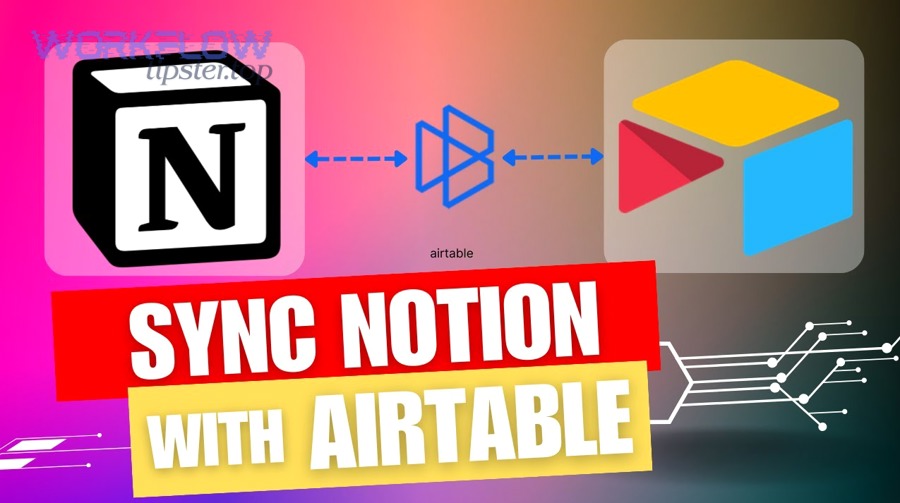
For example, Zapier positions Airtable ↔ Notion as a quick connection path with triggers and actions that can be set up without coding.
What are the prerequisites you need before connecting Airtable and Notion?
There are 6 core prerequisites for connecting Airtable and Notion: permissions, API credentials, a prepared Notion database, a stable Airtable schema, a unique ID strategy, and an owner for the integration, based on what prevents failures and duplicates.
Next, set these up before you touch any automation builder.
- Permissions and access
- Notion: the integration must be invited to the database/page it will read/write.
- Airtable: the token must have access to the base and tables used.
- API credentials
- Notion: create an integration token (or connect via a tool’s OAuth flow).
- Airtable: use a personal access token or tool-based auth.
- Prepared Notion database
- Create properties that match your expected fields (Status, Owner, Due, etc.).
- Ensure property types match the data you plan to push.
- Stable Airtable schema
- Avoid renaming fields mid-setup.
- Confirm select options (single/multi-select) are final.
- Unique ID strategy
- Decide what identifies a record across systems (Record ID, or a custom “External ID”).
- Integration ownership
- Assign a person (or role) responsible for maintenance and changes.
If you skip the ID strategy, you almost always pay for it later with duplicate pages and messy update logic.
What data should you prepare in Airtable and Notion to avoid broken mappings?
There are 4 preparation steps that prevent broken mappings: normalize key fields, align property types, freeze option sets, and create an integration-safe link field, based on the most common causes of mismatched data.
Moreover, each step reduces the need for “patch rules” later.
- Normalize key fields (make them predictable)
- Dates: use one consistent date field for “Due date” rather than scattered date notes.
- Status: use a single source list of statuses (e.g., Backlog/In Progress/Done).
- Align property types (so data lands correctly)
- Text → Notion rich text/title
- Number → number
- Single select → select
- Multi select → multi-select
- URL → URL
- Person/assignee → people (or a text fallback if people mapping is hard)
- Freeze option sets (so select fields don’t break)
- If Airtable has “In review” but Notion doesn’t, mapping fails or creates drift.
- Decide the canonical set, then mirror it.
- Create an integration-safe link field
- Add a field in Airtable like “Notion Page URL” or “Notion Page ID.”
- That field becomes your anchor for updates and troubleshooting.
A small mapping discipline upfront is what makes the rest of the setup feel “easy” later.
How do you set up a 1-way Airtable → Notion sync with a no-code tool?
A 1-way Airtable → Notion sync works best when you follow a 6-step method—choose a trigger, choose a Notion action, map fields, add a dedupe key, test with real records, and then monitor runs—so Airtable updates reliably create or update Notion pages.

Then, once the basic path works, you harden it with “create-or-update” logic and error handling.
Here is the repeatable setup method most no-code tools share:
- Define the sync direction: Airtable → Notion only.
- Choose the trigger: “New record,” “Updated record,” or “Record matches conditions.”
- Choose the Notion action: “Create database item/page” or “Update database item/page.”
- Map fields to properties (carefully).
- Add a dedupe strategy so updates don’t create duplicates.
- Test and monitor: test with 3–5 records, then watch run history.
A practical shortcut: start with “create on new record,” then add “update on changed record” once you’ve confirmed the mapping is correct.
How do you map Airtable fields to Notion properties correctly?
You map Airtable fields to Notion properties correctly by matching types first (title, rich text, select, date, people, URL), then standardizing formats (dates, multi-select lists), and finally validating with real sample records so the Notion database stays clean and searchable.
Specifically, correct mapping is what keeps your Notion pages usable for humans, not just “filled with data.”
This table contains a practical mapping cheat sheet to help you translate Airtable field types into Notion properties without guesswork.
| Airtable field type | Best Notion property type | Notes for clean syncing |
|---|---|---|
| Single line text | Title / Rich text | Use Title for the primary identifier (e.g., Task name) |
| Long text | Rich text | Keep formatting simple; avoid huge payloads |
| Single select | Select | Mirror option values exactly |
| Multi select | Multi-select | Ensure values are separated consistently |
| Date | Date | Use one time zone convention across the team |
| URL | URL | Keep raw URL; store “pretty label” separately |
| Attachment | Files / URL | Many teams store links rather than uploading files |
| User/Collaborator | People / Rich text | People mapping may require consistent email identities |
A common team pattern is to keep Notion “friendly fields” (Title, Status, Due) extremely consistent, and push extra metadata into a “Details” section or secondary properties.
How do you prevent duplicates when new records sync into Notion?
You prevent duplicates by using a single unique key (Airtable Record ID or a custom External ID), searching Notion for an existing page with that key, and then using “update” if found and “create” if not—because duplicates happen when the tool can’t match identities.
However, the key must be stable, not something that changes like a title or status.
A durable dedupe approach looks like this:
- Pick the key
- Fastest: Airtable Record ID
- More portable: a custom “External ID” (like TASK-1029)
- Store the key in Notion
- Create a Notion property called “External ID” (text)
- Always write the key into it during creation
- Before creating a page, search for the key
- Many tools offer a “Find database item” step
- If found → update; if not found → create
- Write back the Notion Page URL to Airtable (optional but powerful)
- Airtable field “Notion Page URL” becomes your operations handle
If you want the simplest operational flow, write back the Notion page URL into Airtable, because it makes audits and manual fixes fast.
How do you keep updates in Airtable reflected in Notion reliably?
You keep updates reliable by triggering only on meaningful field changes, batching updates when possible, and adding retry logic (or at least run monitoring) so temporary failures don’t permanently desync your records.
In addition, the reliability of updates depends on respecting each platform’s API limits and pacing your requests.
Practical reliability tactics teams use:
- Change filters: only sync when Status, Due date, Owner, or a small set of fields changes.
- Scheduling: prefer frequent small runs over rare massive runs.
- Retries: if a tool supports retries, enable them; if not, build a “failed records” view in Airtable.
- Observability: keep a “Last synced at” timestamp and “Sync status” field.
When your integration is running, your goal is boring predictability: small updates, stable identity, and clear visibility into failures.
How do you set up a 2-way sync between Airtable and Notion?
Airtable ↔ Notion 2-way sync works when you define field ownership, set conflict rules, map only safe fields bidirectionally, and test edits on both sides—because two-way syncing fails when both tools can overwrite each other without a clear decision policy.

Next, treat 2-way sync as an engineering project, not a quick toggle.
Two-way sync introduces additional design requirements:
- Field ownership: which system “owns” each field?
- Conflict resolution: what happens when both sides change before the next sync?
- Safety boundaries: which fields are allowed to sync back?
Many teams succeed by making Notion the collaboration layer (notes, rich content, lightweight edits) and Airtable the system of record for structured fields (status, numbers, pipeline metadata). That hybrid pattern reduces conflicts while still giving teams freedom in Notion.
When is 2-way sync a “Yes,” and when should you avoid it?
Yes, 2-way sync is worth it when your team edits important fields in both Airtable and Notion, needs a single shared reality, and can enforce ownership rules; no, you should avoid it when you can’t define field ownership, when conflicts are frequent, or when you sync complex relational fields that don’t translate cleanly.
Meanwhile, the easiest way to decide is to list “fields people edit in Notion” and see whether those edits must affect Airtable.
Choose 2-way sync (Yes) if:
- Notion is where the team actually updates Status/Owner/Due date.
- People need to work offline-like in Notion and still push changes back.
- You can define conflict rules and accept a bit of complexity.
Avoid 2-way sync (No) if:
- Airtable must remain authoritative for compliance or operations.
- Notion edits are mostly notes, not structured data.
- You have frequent concurrent edits to the same fields.
A common compromise is “2-way for a small safe subset of fields” and “1-way for everything else.”
How do you handle conflicts when both sides change the same field?
You handle conflicts by choosing one primary rule—field-level source-of-truth, last-write-wins with timestamps, or manual review queues—then implementing it consistently so the system never silently overwrites critical values.
More importantly, conflict handling should be visible to the team, not hidden.
Here are practical conflict policies teams use:
- Field-level ownership (recommended)
- Example: “Status is owned by Airtable,” “Notes are owned by Notion.”
- If Notion changes Status, the integration rejects it or resets it.
- Last-write-wins (use with caution)
- If both changed, the most recent timestamp overwrites the other.
- Works best when your team rarely edits the same field in both places.
- Manual review queue (best for high-stakes fields)
- Conflicts go into an Airtable view like “Needs review.”
- A human decides the winner and re-syncs.
A strong operational design is to store both “Updated at” timestamps and “Last synced at” timestamps so you can tell whether something changed before or after the sync ran.
Which fields are safest (and riskiest) for 2-way syncing?
There are 2 main groups of fields for 2-way syncing—safe fields (simple scalar values) and risky fields (relational, computed, or identity-sensitive fields)—based on how often mapping breaks or causes conflicts.
Specifically, keeping two-way mapping limited to safe fields is the biggest predictor of success.
Safest fields (usually OK for 2-way):
- Title / name (if stable)
- Plain text
- Numbers
- Dates
- Simple selects (when options are mirrored)
Riskiest fields (often problematic for 2-way):
- Relations / linked records (Airtable linked records vs Notion relations behave differently)
- Rollups and formulas (computed fields don’t translate reliably)
- People fields (identity matching can break across workspaces)
- Attachments/files (uploading vs linking vs permissions)
A mature 2-way sync design uses Airtable for relationships and computed logic, and Notion for human collaboration layers.
Which integration method should teams choose: automation tools, sync tools, or custom API?
Automation tools win for speed, sync tools win for ongoing bidirectional alignment, and custom API is optimal for complex workflows with strict control—because each approach trades simplicity for reliability and flexibility in different ways.
Next, pick your method by aligning it with your team size, data complexity, and governance requirements.
A decision framework that works in real teams:
- Automation tools (fastest time-to-value)
- Best when you can accept polling schedules and simple create/update patterns
- Great for “Airtable → Notion publishing” workflows
- Sync tools (designed for consistency)
- Best for 2-way sync and conflict handling
- Useful when a team truly edits in both tools
- Often includes mapping, monitoring, and stronger identity handling
- Custom API (highest control)
- Best for advanced transforms, large data volumes, and strict security
- Requires engineering time and ongoing maintenance
This is also where cross-workflow thinking helps: if your organization already runs workflows like clickup to slack notifications or freshdesk to google sheets reporting, you may already have a preference for “automation-first” operations that can extend naturally into Airtable ↔ Notion.
What’s the best choice for a lightweight workflow: copy data on triggers or scheduled sync?
Copy-on-trigger wins for simplicity and responsiveness, while scheduled sync is best for steady consistency across many records—because triggers handle “events” well, but scheduled sync handles drift and bulk updates more predictably.
However, the best choice depends on how your data changes.
Copy on triggers (event-driven) is best when:
- You mainly create new records (intake forms, new tasks).
- You want immediate Notion page creation.
- Updates are relatively rare or limited to a few key fields.
Scheduled sync (time-driven) is best when:
- Many records change throughout the day.
- You need Notion to reflect ongoing updates.
- You want a predictable cycle (e.g., every 5 minutes) to reduce missed events.
A common hybrid pattern:
- Trigger: create Notion page immediately on new record.
- Schedule: run a periodic update sync for changed records.
When does building a custom API integration become the best option?
Yes, custom API becomes the best option when you need complex field transforms, high-volume syncing, strict security and audit controls, or specialized behavior like soft-deletes and idempotent updates; no, it’s not ideal when you just need a simple workflow and don’t have resources to maintain code.
Besides, API-based work only pays off when you operationalize it like a product.
A custom API approach is justified if you need:
- Complex transforms: merge multiple tables into one Notion database; normalize statuses; compute derived values.
- Scalability: handle thousands of records with batching and checkpointing.
- Governance: least-privilege access, audit logs, separation of duties.
- Reliability features: idempotency keys, safe retries, backfills, and reconciliation runs.
If your team already supports workflow patterns such as basecamp to dropbox synchronization for files, you’ll recognize the same need here: stable identity, predictable timing, and clear failure recovery.
How do you troubleshoot common Airtable ↔ Notion integration problems?
You troubleshoot Airtable ↔ Notion integration problems by checking authentication and permissions first, then validating field mapping and unique IDs, and finally addressing rate limits and data volume—because most failures come from access, mismatched schemas, or request pacing.
Next, you can fix issues faster by using a consistent diagnostic order instead of guessing.
A clean troubleshooting sequence:
- Permissions/auth (most common)
- Mapping/type mismatches
- Duplicates caused by missing IDs
- Rate limits and throttling
- Deletes and archival behavior
If you keep two operational fields in Airtable—“Notion Page URL” and “Sync Status”—you can see failures immediately and filter to only the records that need attention.
Why does the sync fail due to permissions or authentication, and how do you fix it?
Sync fails because the integration token lacks access to the Notion database/page or the Airtable base/table, because tokens can expire or lose scope, and because some tools connect to the wrong workspace—so fixing it means re-authorizing correctly and re-sharing the correct Notion database with the integration.
To illustrate the fix, treat each platform separately.
Notion permission fixes:
- Confirm the Notion integration is explicitly invited to the target database/page.
- Confirm you are writing to the correct database (not a similar duplicate).
- Reconnect the integration if the token was rotated.
Airtable permission fixes:
- Confirm token scope includes the base and tables used.
- Confirm the base/table names match what the integration expects (renames can break steps).
- If your org uses service accounts, ensure the service account still has access.
When this is fixed, most “mysterious failures” disappear immediately.
How do you handle rate limits, large bases, and slow sync runs?
You handle limits and slow runs by reducing requests per run (batching and filtering), introducing queues and backoff, and syncing incrementally (only changed records), because both Notion and Airtable enforce request limits that punish brute-force syncing.
More specifically, scaling is about “less work per cycle,” not “more retries.”
Scaling tactics that work:
- Incremental sync: sync only records changed since “Last synced at.”
- Batching: group updates; don’t update one field at a time.
- Pagination: read records in pages; checkpoint progress.
- Backoff: when you hit 429, wait and resume.
Evidence: According to a study by the University of California, Irvine, Department of Informatics, in 2008, researchers found that people compensate for interruptions by working faster but experience more stress, frustration, time pressure, and effort, which is exactly what happens when teams must constantly “babysit” flaky automations instead of trusting a stable sync.
What’s the best practice for deletes: delete, archive, or soft-delete?
Archive (soft-delete) is usually best for team safety, hard-delete is best only when data governance demands removal, and “do nothing” is acceptable when Notion is just a publishing layer—because deletes are irreversible mistakes when you don’t have audit-friendly recovery.
In short, you should default to reversible behavior unless you have a strong reason not to.
Recommended patterns:
- Soft-delete (recommended default)
- Airtable has a field like “Archived = true”
- Notion page is moved to an “Archive” view or tagged as archived
- Keeps history and prevents accidental loss
- Hard-delete (use cautiously)
- Deletes the Notion page or removes the Airtable record
- Only use if your team has backups and strict governance
- No delete sync (publish-only)
- If Airtable → Notion is just publishing, you may simply stop updating deleted records
Teams often implement “Archive” because it aligns with human behavior: people delete things by mistake, and operations needs recovery.
What advanced edge cases and best practices make Airtable to Notion sync scalable and safe?
Advanced best practices make Airtable to Notion sync scalable and safe by enforcing idempotent identity, handling attachments intentionally, securing tokens with least privilege, and adding monitoring with replay/rollback patterns—because scale failures happen when you can’t safely retry or audit.

Next, these micro-level choices are what turn a “working integration” into a trustworthy system.
How do you design an external ID strategy for idempotent updates and clean deduplication?
You design external IDs by selecting one immutable identifier, storing it in both systems, and using it as the only matching key for updates—because idempotency means you can run the same update repeatedly without changing the outcome or creating duplicates.
More importantly, external IDs are the backbone of safe retries.
A strong external ID strategy:
- Choose one ID (don’t mix)
- Option A: Airtable Record ID (fastest)
- Option B: Business ID like REQ-2026-00129 (portable across migrations)
- Store it in Notion
- Property: “External ID” (text)
- Always written on page creation
- Store the Notion pointer in Airtable
- Field: “Notion Page URL” or “Notion Page ID”
- Never use mutable fields as keys
- Titles change; statuses change; owners change
This is the single simplest practice that prevents most integration disasters.
How should teams handle attachments and rich content when syncing to Notion?
Teams should handle attachments by linking rather than uploading when possible, standardizing file naming, and separating “structured metadata” from “rich content,” because attachments are the most fragile part of cross-tool syncing due to permissions, payload sizes, and format differences.
Especially in teams, file access must remain consistent for everyone.
Practical options:
- Link-first approach (recommended)
- Store file URLs in Notion
- Keep the file source in a controlled storage system
- Avoids upload failures and keeps permissions centralized
- Upload approach (only if required)
- Use Notion file uploads carefully
- Expect stricter payload constraints and operational overhead
- Hybrid
- Push thumbnails/preview links to Notion
- Keep originals stored elsewhere
A helpful operational convention:
- Airtable: “Attachment URL,” “Attachment Name,” “Attachment Type”
- Notion: “Files (links),” plus a rich text “Assets notes” section
How do you secure tokens and permissions for least-privilege team access?
You secure tokens by scoping access to only needed bases/databases, rotating credentials on a schedule, removing access during offboarding, and separating admin ownership from automation operation—because integrations become invisible security risks when nobody owns their permissions.
In addition, the integration should have access to exactly what it needs, and nothing more.
A least-privilege checklist:
- Create a dedicated integration identity (where possible) instead of a personal account.
- Grant access only to the required Airtable base and tables.
- Share only the required Notion database/pages with the integration.
- Rotate tokens when team members leave or roles change.
- Keep an internal record of: token owner, purpose, and last rotation date.
If your organization already manages operational tools and references (for example, a knowledge page like WorkflowTipster.top that documents integration playbooks), store token ownership and escalation procedures there so the team can respond quickly when something breaks.
What are the best practices for monitoring, alerts, and rollback when sync breaks?
Best practices include logging every run, alerting on failures, keeping a replay queue for missed updates, and implementing rollback with backups or snapshots—because integrations don’t fail once; they fail repeatedly unless you can see and correct them fast.
Thus, the goal is to reduce “silent failure time” to near zero.
Monitoring patterns that work:
- Operational fields in Airtable
- “Sync Status” (OK/Failed)
- “Last Sync Attempt” timestamp
- “Last Sync Error” text (short, actionable)
- Run history review
- Weekly check of failed runs
- Monthly review of volume and throttling
- Replay strategy
- Keep a view “Needs resync”
- Allow a safe rerun without duplicates (requires external ID discipline)
- Rollback strategy
- If a bad mapping pushed incorrect values, revert via a saved snapshot or export
- Prefer reversible changes (archive instead of delete)
When you build these controls, your Airtable ↔ Notion integration stops being a fragile “automation” and becomes a dependable team system that people can trust—even when the tools and data grow.