


You can build an Airtable → Confluence → Google Drive → Dropbox Sign document signing workflow by treating Airtable as the system of record, Confluence as the template-and-approval hub, Google Drive as the storage layer, and Dropbox Sign as the execution layer for eSignature requests—then connecting the stages with consistent IDs, links, and statuses.
Next, if your goal is to eliminate bottlenecks, the most important design decision is where you place human approvals: inside Confluence as a policy gate, inside Airtable as a queue gate, or both—because that choice determines how “automated” the workflow can be without losing control.
Then, to keep the workflow stable in real operations, you need a clear data model for requests, signers, and documents, plus reliable file routing in Google Drive so every signed file returns to the right folder and updates the right Airtable record.
Introduce a new idea: once the pipeline works, the highest leverage improvements come from standardizing templates, locking down permissions, and planning a manual fallback so your teams can keep signing even when an automation step fails.
What is an Airtable → Confluence → Google Drive → Dropbox Sign document signing workflow?
An Airtable → Confluence → Google Drive → Dropbox Sign document signing workflow is a no-code document pipeline that starts with structured intake data, transforms it into a ready-to-sign document, sends it for eSignature, stores the completed file, and writes signature status back to the original request record.
To better understand what you’re building, it helps to see the workflow as a chain of responsibilities—each app handles one job, and the handoffs must be explicit and trackable.

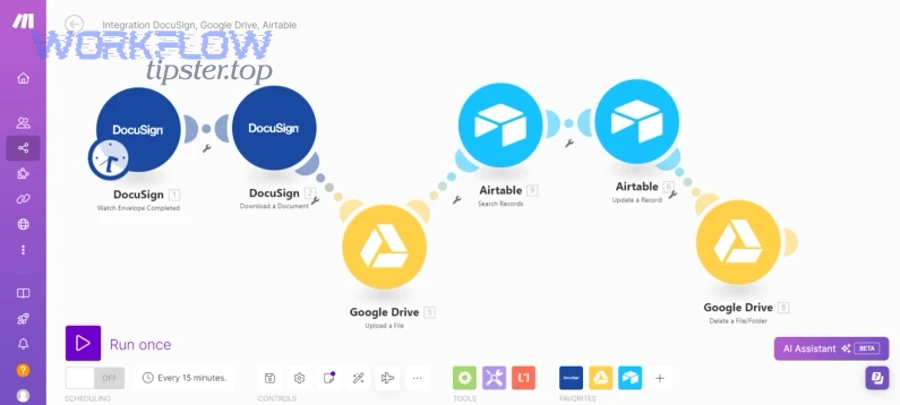
What does each app do in the workflow (Airtable vs Confluence vs Google Drive vs Dropbox Sign)?
Airtable wins in intake and tracking, Confluence is best for controlled documentation and approvals, Google Drive is optimal for file storage and structured retrieval, and Dropbox Sign is strongest for executing eSignature requests with signer order, reminders, and completion artifacts.
However, the “best tool” only matters if the handoff is frictionless. Here’s the practical role mapping most Ops and HR teams use:
- Airtable (system of record):
- Captures the request (who, what, when, why)
- Stores structured signer data (names, emails, roles, order)
- Tracks the state machine: Draft → Ready → Sent → Signed/Declined/Expired
- Stores links: Confluence page link, Google Drive file link, Dropbox Sign request ID, signed PDF link
- Confluence (template-and-policy hub):
- Hosts standardized templates (policy page templates, onboarding checklists, SOPs)
- Enables review/approval routines (comments, page restrictions, approvals via process)
- Provides context that shouldn’t live in a database (legal language rationale, policy history)
- Google Drive (storage and routing):
- Holds source files (generated PDFs, attachments, supporting docs)
- Holds signed outputs (final PDFs, audit/certificate files if provided)
- Enforces folder-based access boundaries (HR-only, regional folders, department-specific shares)
- Dropbox Sign (execution and proof):
- Sends signature requests
- Enforces signer order and identity/verification settings (as configured)
- Provides completion confirmation and downloadable signed files
- Produces a record of “who signed what and when” as part of the signing package (depending on settings)
The hook chain that keeps everything cohesive is one identifier: a Request ID created in Airtable and carried through filenames, page titles, and signature request metadata so you can always reconcile the chain.
Which document types are best suited for this workflow (HR forms, policies, vendor agreements)?
There are 4 main types of documents suited for this workflow: employee HR documents, policy acknowledgements, vendor/legal agreements, and internal operational approvals, based on how standardized the content is and how many signers are involved.
More specifically, you can decide by asking a single question: “Does the document repeat with predictable fields?” If yes, this stack performs extremely well.
- Employee HR documents
- Offer letters, onboarding agreements, handbook acknowledgements
- Typically: one primary signer (employee) plus countersign (HR/manager)
- Strong fit because the metadata is structured and the process repeats
- Policy acknowledgements
- Remote work policy, security training acknowledgment, code of conduct
- Often: single signer, sometimes time-bound recertification
- Strong fit because Confluence can host the policy context while the signing artifact confirms acknowledgement
- Vendor/legal agreements
- NDAs, SOWs, contractor agreements
- Often: multi-party, signer order matters, attachments matter
- Good fit if you standardize templates and control approvals before sending
- Internal operational approvals
- Procurement approvals, exception requests, finance sign-offs
- Often: multiple approvers and conditional routing
- Good fit if you design the workflow state machine carefully and build a fallback path
Can you automate document signing end-to-end with no-code tools in this stack?
Yes, you can automate document signing end-to-end in this stack because you can (1) standardize intake in Airtable, (2) generate or select a signing-ready document, and (3) trigger a Dropbox Sign request while automatically storing and syncing signed outputs back to Airtable.
In addition, “end-to-end” only stays true if you treat permissions, approvals, and exceptions as first-class workflow steps rather than afterthoughts.


What prerequisites do you need before automation (accounts, permissions, templates, folders)?
There are 5 main prerequisites you need before automation: account access, permission design, templates, folder architecture, and data validation, based on the criterion of “can the workflow run without a human fixing basics mid-flight?”
To illustrate, here’s the checklist Ops/HR teams use to avoid the most common “we built it but it breaks” scenario:
- Account access (who can do what)
- Airtable: workspace/base access for builders; interface access for requesters
- Confluence: space permissions for editors/approvers; view permissions for requesters (optional)
- Google Drive: editor access for automation runner/service; view access for stakeholders
- Dropbox Sign: admin access for template creation; sending permission for automation runner
- Permission design (least privilege)
- Decide which data is sensitive (PII, compensation, legal terms)
- Decide where it lives (Airtable fields vs Confluence secure pages vs Drive restricted folders)
- Decide who sees the signed file vs only sees status
- Templates (repeatability)
- Confluence templates for policy content and standardized wording
- Dropbox Sign templates if you use form fields and consistent layouts
- A documented “template governance” rule: who can change it, and how changes are approved
- Folder architecture (routing confidence)
- A folder structure that doesn’t require humans to “decide where it goes”
- Naming conventions that include Request ID, doc type, signer name, and date
- Data validation (prevent bad sends)
- Required fields in Airtable (signer email, doc type, approval status)
- Checks that block sending if critical fields are missing or invalid
- Clear statuses that reflect readiness: Draft vs Ready-to-Send
When these prerequisites are done, automation becomes a predictable system instead of a brittle set of triggers.
What’s the difference between a no-code workflow and a manual workflow here?
A no-code workflow wins in speed and consistency, a manual workflow is best for rare exceptions and high-judgment cases, and a hybrid approach is optimal when you need approvals before sending but still want automated storage and status tracking afterward.
Meanwhile, the real distinction is not “tools vs no tools.” It’s whether your process has a repeatable decision structure.
- No-code (automated) workflow
- Pros: faster cycle time, fewer missed steps, reliable audit artifacts, scalable volume
- Cons: requires setup discipline; failures must be handled with a fallback plan
- Best when: docs repeat, signer patterns repeat, routing rules are stable
- Manual workflow
- Pros: flexible, easy for unusual cases, minimal setup
- Cons: inconsistent storage, harder status visibility, higher error risk at scale
- Best when: one-off legal edits, nonstandard signer requirements, urgent exceptions
- Hybrid workflow
- Pros: keeps control while still reducing busywork
- Cons: requires clear gates so the workflow doesn’t “stall between humans”
- Best when: Ops/HR wants approvals and oversight but still wants automation to handle routing and tracking
How do you build the workflow step-by-step from intake to signed document storage?
Build the workflow using 6 steps—intake, validate, prepare the document, route the file, send the signature request, and sync status—so the outcome is a signed document stored in Google Drive with complete status and links written back to Airtable.
Then, the most important step is to keep the same Request ID across every stage so the workflow remains traceable even when something fails.

How do you design the Airtable base (tables, fields, views) to track signing status?
There are 3 main table groups you should build in Airtable: Requests, Signers, and Documents, based on the criterion of “one request may involve multiple signers and multiple files.”
Specifically, the design goal is simple: any stakeholder can open Airtable and answer, in seconds, “Where is this document right now?”
1) Requests table (the anchor)
- Core fields:
- Request ID (unique, immutable)
- Requester (user, team, email)
- Document type (single select)
- Status (single select)
- Approval status (Pending/Approved/Rejected)
- Due date (date)
- Dropbox Sign request ID (text)
- Confluence page link (URL)
- Drive folder link (URL)
- Signed PDF link (URL)
- Recommended computed fields:
- Days in status (formula)
- SLA breach flag (formula/checkbox)
- Ready to send? (checkbox derived from validation)
2) Signers table (normalized signer data)
- One record per signer per request
- Fields:
- Request ID (linked to Requests)
- Signer role (Employee/Manager/HR/Legal/Vendor)
- Name
- Order (number)
- Signed timestamp (date/time)
- Signer status (Pending/Signed/Declined)
3) Documents table (file objects + versions)
- One record per file per request
- Fields:
- Request ID (linked)
- Document version (v1/v2)
- Drive file link
- File type (PDF/DOCX)
- Generated from (Confluence/Upload/Template)
- Final? (checkbox)
Views (operational queues)
- Ready to Send
- Waiting for Signature
- Signed (Completed)
- Exceptions (Failed / Needs Review)
- Expiring Soon (time-based reminders)
Airtable becomes the “control tower.” The automation can fail and you still have visibility because the base tells the truth about state.
How do you map Airtable fields to the document and signer data (templates + merge fields)?
Map Airtable fields to documents by defining a stable “field contract” (a fixed set of canonical field names), validating those fields before generation, and using the same canonical fields to create the Dropbox Sign signer list and request metadata.
Moreover, mapping succeeds when it is strict—not when it is flexible. A strict mapping prevents subtle HR/ops errors like sending an offer letter to the wrong email or generating the wrong start date.
A practical mapping method
- Define canonical field names
- Example:
employee_full_name,employee_email,start_date,manager_name,department,title
- Example:
- Validate required fields
- Block sending if
employee_emailis empty or malformed - Block sending if
start_dateis blank
- Block sending if
- Create a signer model
- Build signers from the Signers table (order + role)
- Enforce “email required” and “order required”
- Attach the Request ID everywhere
- In doc header/footer (if appropriate)
- In filename
- In Dropbox Sign request subject/message
- In Airtable record
A quick reference table
This table shows how a canonical Airtable field can map to each layer of the workflow.
| Airtable field (canonical) | Document placement | Dropbox Sign usage | Tracking usage |
|---|---|---|---|
| request_id | Header or filename | Subject / metadata | Primary reconciliation key |
| employee_full_name | Document body | Signer name | Display + audit clarity |
| employee_email | Not printed | Signer email | Delivery + signer identity |
| start_date | Document body | Optional message | HR timeline validation |
| doc_type | Document title | Subject grouping | Reporting and routing |
If you keep the mapping consistent, your workflow becomes maintainable even when templates evolve.
How do you route files in Google Drive (folder structure, naming, version control)?
There are 3 main routing strategies for Google Drive files: by team, by document type, and by time, based on the criterion of “how people will search for documents after they’re signed.”
Especially for Ops/HR, searchability beats aesthetics. A folder structure that “feels tidy” but makes retrieval hard will create manual work later.
Recommended folder architecture
- Top level:
Signed DocumentsHROffersOnboardingPolicies
OperationsVendorsProcurementExceptions
Naming convention
A strong filename makes the file self-explanatory even when viewed outside Airtable:
[RequestID]_[DocType]_[PrimarySignerLastName]_[YYYY-MM-DD]_v[Version].pdf
Example: REQ-10482_OfferLetter_Nguyen_2026-02-02_v1.pdf
Version control rule
- Store drafts (pre-sign) in a “Drafts” subfolder or as versioned files
- Store signed finals in a “Final Signed” subfolder
- Never overwrite the signed final; treat it as immutable
This routing approach protects you from the common failure where a signed PDF exists but nobody can find it—or worse, someone finds the wrong version.
Which automation pattern is best for Ops & HR teams: template-based signing or document-generated signing?
Template-based signing wins in speed and standardization, document-generated signing is best for highly customized content, and a hybrid pattern is optimal when you want standardized structure but still need dynamic clauses per request.
On the other hand, the “best pattern” is the one that matches your document variability—so let’s compare them in the way Ops and HR teams actually experience them.
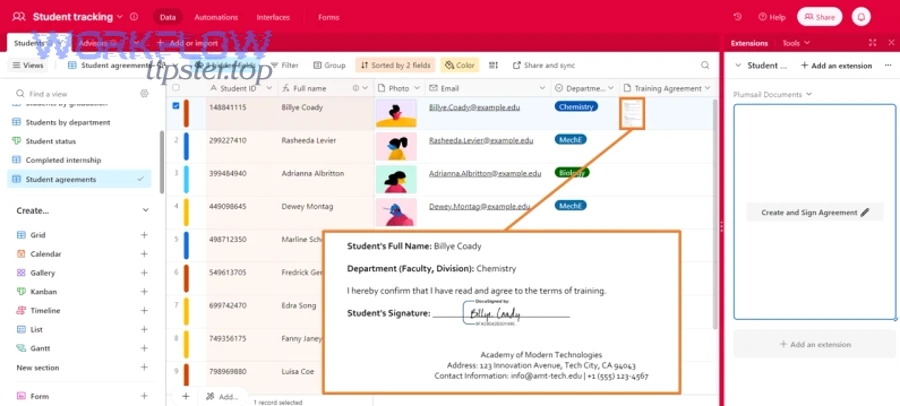
When should you use Dropbox Sign templates vs sending a custom PDF each time?
Dropbox Sign templates win in repeatable forms and stable layouts, custom PDFs are best for documents with frequent bespoke changes, and a mixed approach is optimal when most of the document is standard but a few sections vary.
To illustrate, you can decide using a simple scoring approach: layout stability and content variability.
Use Dropbox Sign templates when:
- The document layout stays the same (fields in consistent positions)
- You want reusable form fields and standardized signer experience
- You want faster setup per request (select template, fill variables, send)
- Examples: acknowledgements, standard HR forms, routine vendor NDAs
Use custom PDFs when:
- Each request changes the content significantly
- Legal terms or role-based clauses vary by case
- Attachments change often
- Examples: complex contracts, tailored offer letters with variable clauses, multi-appendix agreements
A hybrid approach
- Use templates for the predictable parts (signature blocks, identity fields)
- Generate the core content from Confluence/Drive into a PDF
- Attach the PDF and still enforce signer order through Dropbox Sign
This is where the hook chain matters: your workflow stays coherent if Airtable is always the authoritative source for status and IDs, regardless of the document pattern.
How do approvals fit in (policy review in Confluence vs approval flags in Airtable)?
Confluence approvals are best for content governance and policy review, Airtable approval flags are best for operational gating and queue management, and a combined approach is optimal when you need both document integrity and process control.
Besides, approvals should be treated as a “gate” that turns Draft into Ready-to-Send, not as an informal conversation that happens off to the side.
Approval pattern A: Confluence-first
- Best when: policy language and documentation must be reviewed centrally
- Flow:
- Draft policy page or document notes in Confluence
- Reviewer approves (via agreed process)
- Airtable status flips to Ready-to-Send
Approval pattern B: Airtable-first
- Best when: approvals are operational (manager sign-off, HR queue)
- Flow:
- Request created in Airtable
- Approver checks a box or selects Approved
- Automation sends Dropbox Sign request
Approval pattern C: Combined
- Best when: you need policy governance plus execution gating
- Flow:
- Confluence = “Is this the right content?”
- Airtable = “Is this request ready right now?”
This prevents a common failure mode: people assume a request is approved because they saw a Confluence comment, but Airtable still shows Draft and the automation never sends.
What are the most common failure points and how do you troubleshoot them?
There are 6 common failure points in this workflow—invalid signer data, missing approvals, file permission errors, wrong folder routing, status sync gaps, and duplicates—based on where the pipeline breaks between intake, signing, and storage.
In short, troubleshooting works best when you diagnose by stage and fix the “cause class,” not the single symptom.

Why do signature requests fail (invalid signer data, permissions, file access), and how do you fix it?
Signature requests fail because the workflow depends on correct identity data and correct access paths, and the fastest fix is to validate signer fields, enforce required approvals, and confirm the automation runner can access the source document and destination folder.
More importantly, you want to prevent failures before they happen by placing checks in Airtable that stop bad requests from entering the “send” queue.
Failure class 1: Signer identity problems
- Symptoms:
- Bounced emails
- “Signer not reachable”
- Signer claims they didn’t receive the request
- Fixes:
- Validate email format in Airtable
- Use a dedicated “Signer email verified?” step for sensitive workflows
- Store a secondary contact method (optional) for manual escalation
Failure class 2: Approval gate issues
- Symptoms:
- Automation doesn’t run
- Request stays stuck in Draft
- Fixes:
- Use a single explicit Approved value in Airtable that the automation checks
- Make approval a required field, not a comment thread
- Record “Approved by” and “Approved timestamp” for traceability
Failure class 3: File and permission issues
- Symptoms:
- Automation can’t attach the file
- Signed output can’t be saved to the intended folder
- Fixes:
- Ensure the automation runner has Drive access to source + destination
- Use shared drives or team-owned folders rather than personal folders
- Standardize folder creation rules so paths are predictable
Failure class 4: Wrong document version sent
- Symptoms:
- Signers receive an outdated document
- Fixes:
- Store the Drive file link for “Final Draft” explicitly
- Add a “Final Draft locked?” checkbox
- Include version in the filename so humans can spot mistakes
These fixes keep your workflow resilient without turning every run into a manual support ticket.
How do you prevent duplicates and keep status accurate in Airtable?
Prevent duplicates and keep status accurate by using one immutable Request ID, storing the Dropbox Sign request ID back into Airtable, and applying “send-once” logic that blocks re-sends unless a human explicitly resets the request.
Thus, the core concept is idempotency: the same request should not create a second signature request unless you intended it.
A practical duplicate-prevention design
- Send lock
- Airtable field:
sent_attimestamp - Automation rule: only send when
sent_atis empty AND status is Ready-to-Send
- Airtable field:
- External request ID storage
- Airtable field:
dropbox_sign_request_id - If present, never create a new request automatically
- Airtable field:
- Reset protocol
- A separate field:
resend_authorized(checkbox) - Only a manager/HR admin can set it
- A separate field:
- Reconciliation view
- A view that shows:
- Ready-to-Send but missing file link
- Sent but missing request ID
- Signed status but missing signed PDF link
- A view that shows:
When status tracking is accurate, Ops and HR stop chasing updates through email threads—and the workflow becomes self-explanatory.
How do you optimize, secure, and scale this document signing workflow for real teams?
Optimize, secure, and scale the workflow by enforcing least-privilege access, minimizing sensitive data exposure, standardizing audit artifacts, and adding advanced patterns like conditional signers and bulk sends—so the system remains fast without becoming risky.
Next, this is where micro semantics matter: you move from “it works” to “it works reliably under real constraints.”

How can you make the workflow more secure (least privilege, PII minimization, access segmentation)?
There are 4 main ways to secure this workflow: least privilege permissions, PII minimization, access segmentation, and link hygiene, based on the criterion of “who can see what, and how easily can that be abused?”
Specifically, you want to reduce risk without slowing down execution.
- Least privilege
- Give requesters interface-level access in Airtable, not base-builder access
- Restrict Confluence pages that contain policy drafts or sensitive rationale
- Limit Drive folder sharing to the smallest group that needs it
- PII minimization
- Store only what you must in Airtable (e.g., email, role, Request ID)
- Avoid duplicating compensation or sensitive notes across multiple tools
- Prefer linking to a secured document over copying sensitive text
- Access segmentation
- Separate folders by department or region when required
- Use separate Confluence spaces for HR vs broader operations if needed
- Use role-based views and interfaces in Airtable
- Link hygiene
- Avoid “anyone with the link” for signed outputs
- Use team-owned shared drives so access survives employee turnover
- Keep signed documents immutable (no edits, no overwrites)
This security approach protects the pipeline without forcing everyone into a slow, manual process.
What compliance and audit trail practices matter for HR and operations (logs, retention, evidence)?
There are 4 main audit practices that matter most: retention rules, immutable final artifacts, traceable approvals, and complete status history, based on the criterion of “can you prove what happened later without reconstructing it from memory?”
Moreover, the workflow should produce evidence naturally as a byproduct of execution.
What to capture for audit readiness
- The Request ID and document type
- Who approved the request (and when)
- Who signed (and when) and which version they signed
- Where the signed PDF is stored (final link)
- Any exception outcomes (declined, expired, resent authorized)
According to a study by Stanford University from the Stanford Institute for Human-Centered AI and the Stanford Digital Economy Lab, in 2025, 69.4% of workers said they welcome automation that frees them up for higher-value work—making audit-friendly automation especially valuable when it replaces repetitive administrative tasks. (news.stanford.edu)
How do you handle advanced signing scenarios (multi-party, conditional signers, bulk sends)?
There are 3 main advanced scenarios you should plan for: multi-party signing, conditional signer routing, and bulk sending, based on the criterion of “does the signer list change per request or per policy?”
To begin, treat these as controlled extensions of the same pipeline—not entirely new workflows.
1) Multi-party signing
- Store signers in the Signers table with explicit order
- Use roles (Employee, Manager, HR, Legal, Vendor) to control templates and messaging
- Include a rule: if any signer declines, status becomes Declined and the request moves to Exceptions
2) Conditional signers
- Use Airtable logic to select signers based on criteria:
- Department
- Region
- Contract value threshold
- Employment type (contractor vs full-time)
- Keep the rules visible in Airtable (a “Routing explanation” field) so humans can trust the automation
3) Bulk sends
- Use a “Batch ID” field to group requests
- Throttle sending to avoid rate limits or email flooding
- Include a checkpoint view: “Batch ready” before sending begins
If you build these patterns into your data model early, scaling becomes a configuration change—not a redesign.
What’s the best “manual fallback” plan when automation breaks (recover vs rerun vs rebuild)?
No-code fallback wins when you can recover by resending or reattaching, a manual run is best when time is critical and errors are localized, and a rebuild is optimal when the failure reveals structural gaps like missing IDs, unclear approvals, or broken permission boundaries.
In addition, the fallback plan should be documented as an SOP and linked inside the workflow so anyone can execute it under pressure.
A simple fallback SOP (recommended)
- Recover
- Confirm the Request ID, correct doc version, correct signer list
- Fix the single error (permission, missing field, wrong link)
- Re-run the step only
- Manual run
- Send the signature request directly (as authorized)
- Save the signed PDF to the correct Drive folder
- Update Airtable fields manually (request ID, signed link, status, timestamps)
- Rebuild
- Trigger when the same failure repeats
- Add validation fields, tighten gating, adjust folder rules
- Document the fix so the system improves over time
This is also a good place to keep your broader automation library coherent: teams often run adjacent automation workflows for incident response and scheduling, including patterns such as “github to basecamp to slack devops alerts”, “calendly to google calendar to microsoft teams to linear scheduling”, or “github to asana to discord devops alerts” when they standardize how requests, statuses, and notifications move across tools.