


To connect and sync Airtable to Linear issues, set up an automation that turns a qualifying Airtable record into a Linear issue, then writes the Linear issue ID/link back into Airtable so future updates can stay aligned across both tools.
Next, you’ll make the integration reliable by defining what “sync” means for your team (one-way vs two-way), choosing which fields are owned by Airtable vs owned by Linear, and mapping statuses so intake stays clean while execution stays accurate.
Then, you’ll decide whether a simple “connect” is enough or whether you need true syncing logic, based on your product workflow, your volume of requests, and how much governance you need across multiple teams and stakeholders.
Introduce a new idea: once the core workflow works, the fastest wins come from preventing duplicates and conflicts—because every unnecessary issue, rerun, or overwritten update creates more context switching than the automation was meant to remove.
What does it mean to “connect” Airtable to Linear issues (and what exactly gets synced)?
Airtable-to-Linear “connect and sync” means an Airtable record is used as the source of truth for intake, a Linear issue is created (or updated) from that record, and a defined set of fields stays aligned in one direction or both directions over time.
Specifically, this matters because “connect” can mean a one-time create, while “sync” implies ongoing updates—so you need clear ownership rules before you map fields and automate changes.

In practice, Airtable is often the intake layer where requests are captured, enriched, and approved, while Linear is the execution layer where work is prioritized, assigned, and completed. The integration is the “bridge” that prevents manual copy-paste and reduces the risk that a request gets lost between tools.
To keep terminology consistent, use one hook phrase across the article: “Airtable record → Linear issue → write back Linear issue ID → sync selected fields.” That hook chain will guide every setup decision you make.
When teams say “sync,” they usually mean one of these patterns:
- One-way create: Airtable creates a Linear issue once, and Airtable stores the Linear issue link/ID.
- One-way update: Airtable updates certain fields on the Linear issue when the Airtable record changes (or the reverse).
- Two-way sync: Both tools can update certain fields, with strict rules to avoid overwriting each other.
- Hybrid sync: Airtable owns intake fields; Linear owns execution fields; only a limited set is synchronized in each direction.
What is the minimal Airtable → Linear issue workflow you can set up in 15 minutes?
The minimal workflow is: trigger on a qualifying Airtable record → create a Linear issue in the right team → write the Linear issue URL/ID back to the Airtable record, so you get a stable link between intake and execution.
To begin, keep it intentionally small: one table, one view (or one filter), one Linear team, and a single “Approved” gate. This prevents early complexity from breaking the hook chain.
Here’s the minimum set of fields that makes the integration functional and traceable:
- Airtable: Request title, description, requester, priority, status, approved (checkbox), and a field to store Linear Issue URL (or Linear Issue ID).
- Linear: Team, title, description, priority, state, and optionally assignee/labels.
More importantly, the “write back” step is what transforms a basic automation into a maintainable system. Without the Linear issue ID/link in Airtable, you cannot reliably update the same issue later, and you cannot reliably prevent duplicates.
Which Airtable fields should map to which Linear issue fields for a product team?
There are 3 main mapping groups for Airtable fields to Linear issue fields: must-have, recommended, and optional, based on the criterion of what’s required to create accurate work vs what improves triage quality.
For example, must-have fields ensure the issue is actionable, recommended fields ensure it is prioritized correctly, and optional fields improve reporting and future routing.
This table contains a practical field-mapping blueprint that helps product teams map intake data (Airtable) into execution-ready work items (Linear) without overcomplicating the first version.
| Mapping Group | Airtable Field | Linear Issue Field | Why it matters |
|---|---|---|---|
| Must-have | Title | Title | Creates a scannable backlog and prevents “mystery issues.” |
| Must-have | Description / Details | Description | Captures reproduction steps, context, and acceptance criteria. |
| Must-have | Product Area / Category | Team (or Label) | Routes work to the correct Linear team or ownership group. |
| Recommended | Priority | Priority | Aligns urgency so triage doesn’t become a meeting-heavy bottleneck. |
| Recommended | Status | State | Creates a shared language for “in review,” “in progress,” and “done.” |
| Optional | Assignee suggestion | Assignee | Helpful when a stable owner exists; risky if it auto-assigns incorrectly. |
| Optional | Attachments / Links | Description (links) | Works best as URLs; file syncing is often tool-dependent. |
As a semantic SEO note, “Linear issue” is a meronym of “Linear” because issues are a core component of the Linear product experience. That’s why the title and the structure keep using “Linear issues” rather than generic “tasks.”
Do you need a “no-code” integration tool to connect Airtable to Linear?
Yes—most product teams should use a no-code tool to connect Airtable to Linear because it is faster to ship, easier to maintain, and safer for non-engineers to adjust than custom code, especially when the goal is reliable issue creation and controlled syncing.
However, the key decision is not “no-code vs code,” it’s “simple connect vs governed sync,” because a poorly-defined sync creates more chaos than it removes.

Here are the three practical reasons no-code usually wins for this use case:
- Speed: You can implement an end-to-end record → issue workflow quickly and iterate weekly as your intake evolves.
- Governance: You can restrict who can edit mappings, require approvals, and document field ownership rules.
- Maintainability: When a field name changes or a workflow state evolves, you can update the mapping without a deployment cycle.
In addition, a no-code approach fits naturally into a broader ecosystem of Automation Integrations—for example, if you already automate airtable to figma for design handoffs or airtable to gitlab for engineering tracking, your team will recognize the same building blocks: triggers, mappings, filters, and write-backs.
Is one-way sync enough for most product teams (Yes/No)?
Yes, one-way sync is enough for most product teams because it reduces duplicates, avoids field conflicts, and keeps Linear as the execution source while Airtable remains the intake source, which is simpler to govern and easier to debug.
More specifically, one-way sync works best when your workflow looks like “submit → qualify → ship,” and you want Linear to reflect qualified work rather than every raw request.
One-way sync is especially strong when:
- Your Airtable base is used for intake triage, stakeholder requests, or customer feedback aggregation.
- Your team wants Linear to contain only actionable work items, not every unfiltered submission.
- You want to prevent “ping-pong editing” where two systems overwrite each other’s updates.
According to a study by the University of California, Irvine from the Informatics research group, in 2005, workplace activity was found to be highly fragmented, with a large share of work spheres being interrupted—highlighting why fewer sync pathways can reduce unnecessary switching.
When does two-way sync become necessary (and when is it risky)?
Two-way sync becomes necessary when both Airtable and Linear must remain accurate reporting surfaces for different stakeholders, but it is risky because it can overwrite updates, create conflicting statuses, and amplify errors when field ownership is unclear.
On the other hand, when you define ownership rules and restrict syncing to a small set of fields, two-way syncing can deliver a “single narrative” across teams without forcing everyone into one tool.
Two-way sync is most justified when:
- Airtable is a stakeholder portal and must show real-time delivery status without manual updating.
- Linear is updated rapidly by engineers and PMs, and stakeholders need visibility in Airtable.
- Compliance or reporting requires that Airtable reflects the latest execution state.
Two-way sync becomes risky when:
- Status fields do not have a clean mapping (for example, “Blocked” exists in one tool but not the other).
- Multiple users edit the same field in different tools within short time windows.
- You have not implemented a deduplication key (Linear issue ID stored in Airtable) before enabling updates.
In short, if you cannot clearly explain who owns each field, two-way sync will feel like an “automation lottery.” That is why the article keeps returning to the hook chain: record → issue → write back → sync selected fields.
How do you set up Airtable → Linear issue creation step-by-step?
You set up Airtable → Linear issue creation with 6 steps—prepare fields, define a qualifying view, connect accounts, configure the trigger, map fields into a Linear issue action, and test with edge cases—so approved Airtable records reliably become Linear issues.
Then, you harden the workflow by adding write-back fields, gating rules, and a “do not recreate” check so the automation stays stable as volume grows.
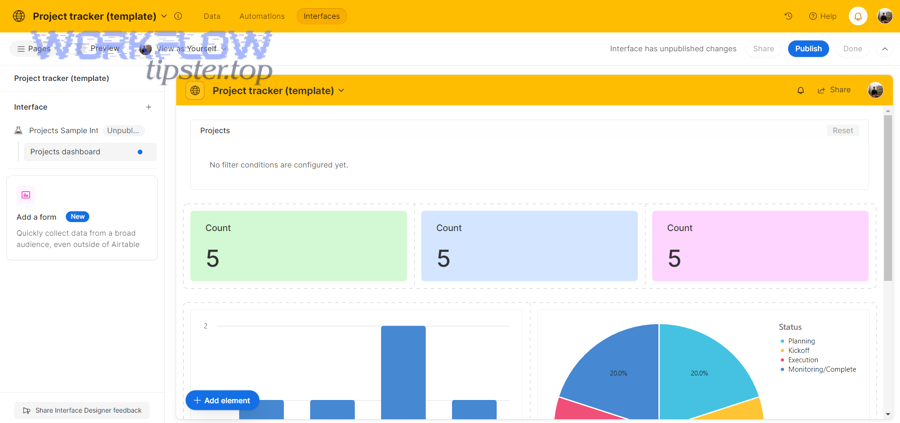
Here is the step-by-step setup most teams can follow regardless of which no-code platform they choose:
- Define the Airtable table: pick the single table that represents “requests” or “work candidates.”
- Add required fields: title, description, product area/category, priority, approved gate, and a “Linear Issue ID/URL” field.
- Create a qualifying view: for example, “Approved & Not Yet Created,” filtered by Approved = Yes and Linear Issue ID is empty.
- Connect Airtable + Linear: authenticate with the minimum permissions required to create issues in the correct team.
- Build the trigger: “when record enters view” or “when record matches conditions.”
- Build the action: “create Linear issue,” map title, description, team, priority, labels, and optionally assignee.
- Write back: store the Linear issue ID and URL into Airtable immediately after creation.
- Test & iterate: test three categories—perfect record, missing fields, and ambiguous routing—to prove it behaves correctly.
One practical pattern that scales well is to format your Linear issue description with an intake template. For example: Summary, context, steps to reproduce (if bug), desired outcome, acceptance criteria, and a link back to the Airtable record.
As your team matures, you can reuse this same setup pattern for adjacent workflows—like pushing approved design requests from Airtable into Figma comments (airtable to figma) or moving engineering work items into Git repositories (airtable to gitlab)—but the stable core stays the same: qualify, create, write back, sync.
What prerequisites should you prepare in Airtable and Linear before connecting them?
The prerequisites are: a clean Airtable intake schema, a gated “approved” path, and a clear Linear team/workflow setup, because the integration can only automate what your structure makes unambiguous.
Next, treat prerequisites as a checklist rather than a “nice-to-have,” since missing fields and unclear routing are the top reasons issue automations create noise.
Airtable prerequisites:
- One canonical table for requests (avoid duplicates across multiple similar tables).
- Required fields enforced (use validation or process discipline): Title, Description, Category, Priority.
- A single select “Status” with definitions (e.g., New, In Review, Approved, Sent to Linear, Closed).
- A checkbox or single select gate: Approved = Yes.
- A dedicated field for Linear Issue ID and Linear Issue URL.
- A view that represents “ready to create,” e.g., Approved and no Linear Issue ID.
Linear prerequisites:
- A clearly identified Linear team where issues should be created.
- Workflow states that match how your team works (at least a To Do / In Progress / Done flow).
- Labels aligned to your intake categories (bugs, requests, tech debt, customer escalation).
- Permissions that allow issue creation but avoid over-broad access when possible.
How do you test the integration to confirm the right issues are created?
You test the integration by running three test cases—a perfect record, a borderline record, and a broken record—then verifying that each produces the expected Linear issue fields, routing, and write-back values in Airtable.
Moreover, testing is where you protect the hook chain, because a workflow that “mostly works” will still create enough friction to make teams abandon it.
Use this lightweight test protocol:
- Perfect record: all required fields present, Approved = Yes, category maps cleanly to a Linear team.
- Borderline record: category ambiguous, priority missing, or description short—confirm your defaults behave safely.
- Broken record: Approved = Yes but title empty, or routing invalid—confirm the automation stops, logs an error, or routes to a fallback “triage” team rather than creating junk.
After each run, verify:
- The Linear issue title and description are readable and include a link back to Airtable.
- The correct Linear team and workflow state were applied.
- The Airtable record now contains the Linear issue ID/URL (write-back succeeded).
- Airtable no longer qualifies for “ready to create” view (prevents duplicates).
According to Microsoft Work Trend Index research published in June 2025, employees using Microsoft 365 are interrupted frequently—“on average, every 2 minutes” by meetings, emails, or notifications—so a well-tested automation that removes manual status updates can reduce avoidable disruption.
How do you keep Airtable and Linear “in sync” after the issue is created?
You keep Airtable and Linear in sync by storing a stable Linear issue ID in Airtable, defining field ownership (who can update what), and syncing only the fields that support your workflow—typically status/state and priority—so updates stay consistent without conflicts.
Besides, syncing is not a feature you “turn on”; it is a set of rules you design so the two systems don’t argue with each other.

A practical way to think about sync is to define two lanes:
- Intake lane (Airtable-owned): requester details, request source, business impact notes, stakeholder approvals, and intake category.
- Execution lane (Linear-owned): state, assignee, cycle/sprint, estimates, engineering notes, and completion signals.
When you only sync what each side is best at, you preserve the integrity of both tools and keep the integration from becoming a fragile “everything mirrors everything” machine.
How do you store the Linear issue link/ID in Airtable to enable updates later?
You store the Linear issue link/ID in Airtable by writing back a dedicated “Linear Issue ID” (and optionally “Linear Issue URL”) field immediately after issue creation, because that ID becomes the unique key that prevents duplicates and allows safe updates.
Then, you use that key as the condition for every future update action: if the ID exists, update the existing issue; if it does not, create a new issue.
To implement this cleanly:
- Create two Airtable fields: Linear Issue ID (text) and Linear Issue URL (URL).
- After the “create issue” action, add a “update record” action that writes those values back.
- Update your qualifying view/filter so only records with an empty Linear Issue ID are eligible to create new issues.
This write-back approach is the most effective deduplication mechanism because it turns your automation into a stateful system rather than a repeated “fire and forget” trigger.
How do you map Linear workflow states to an Airtable status field?
Exact state matching wins for precision, normalized categories win for stability, and a hybrid mapping is optimal for product teams that want both stakeholder-friendly reporting and engineering-level detail.
However, the most important step is to define a mapping that does not break when Linear states evolve, because teams often add states like “Blocked,” “In Review,” or “Ready for QA.”
Two mapping styles work well:
- Normalized mapping: Airtable status uses a small stable set (New, In Review, Approved, In Progress, Done), and Linear state is translated into those categories.
- Exact mapping: Airtable status mirrors Linear states exactly; this is accurate but fragile if states change.
For stakeholder visibility, normalized mapping is usually better. For internal engineering dashboards, exact mapping can be useful if you have strong change control. Many teams do both: an internal “Linear State” field and an external “Stakeholder Status” field.
What rules should you use to decide which Airtable records become Linear issues?
There are 4 main rule groups to decide which Airtable records become Linear issues: gating, quality, routing, and deduplication, based on the criterion of only promoting actionable, well-formed intake into execution.
More importantly, these rules protect Linear from being flooded, while still ensuring high-impact requests reach the backlog quickly.

Rule group 1: Gating rules ensure only approved items create issues. Examples include “Approved = Yes,” “PM reviewed,” or “Score ≥ threshold.”
Rule group 2: Quality rules ensure the request is complete enough. Examples include “Title not empty,” “Description length ≥ X,” or “Has reproduction steps.”
Rule group 3: Routing rules ensure the issue goes to the right team. Examples include “Category = Billing → Team Billing” and “Category = Mobile → Team Mobile.”
Rule group 4: Deduplication rules ensure the automation does not recreate issues. Examples include “Linear Issue ID is empty,” or “Duplicate check by request hash.”
Which filtering rules reduce noise while keeping important requests?
There are 5 high-impact filtering rules that reduce noise while keeping important requests: approval gating, minimum detail requirements, priority thresholds, request type classification, and source-based routing, because these filters prevent low-signal intake from becoming backlog clutter.
For example, a single “Approved” gate is powerful, but the biggest improvement comes when you also require a complete description and a clear type.
Use filters like these:
- Approval gate: Approved = Yes (or “Triage status = Approved”).
- Detail gate: Description is not empty; optionally enforce a minimum character count.
- Type gate: Type is one of Bug, Feature Request, Tech Debt, Customer Escalation.
- Priority gate: Priority is P0/P1/P2; skip P3 unless approved by a specific owner.
- Source gate: Only create Linear issues automatically for sources like “Customer support escalations” or “Sales commitments,” while keeping “ideas” as Airtable-only until reviewed.
If you also run parallel workflows like google docs to mailchimp (content approvals into campaigns), you already understand the core idea: the automation should not publish everything; it should publish what is ready.
How do you route issues to the right Linear team based on Airtable data?
You route issues to the right Linear team by building a category-to-team mapping and applying it consistently during issue creation, so each Airtable record deterministically selects the correct Linear team (with a safe fallback for unknown categories).
Next, treat routing as a small “taxonomy project,” because routing failures are the hidden cause of duplicate work and delayed triage.
A simple routing design looks like this:
- Airtable field: “Product Area” single select (e.g., Billing, Mobile, Integrations, Growth).
- Mapping logic: If Billing → Linear Team Billing; if Mobile → Linear Team Mobile; if unknown → Linear Team Triage.
- Fallback rule: If category is empty or unknown, route to Triage and label as “Needs routing.”
The best routing systems also create transparency: in Airtable, store the chosen team in a “Target Team” field so reviewers can see where the issue will land before approving it.
Which setup is better for product teams: “connect” vs “sync” Airtable with Linear issues?
“Connect” wins in speed and simplicity, “sync” is best for ongoing stakeholder visibility, and a hybrid approach is optimal for scaling product teams that need governance without constant manual updates.
Meanwhile, the right setup depends less on the tools and more on your operating model: who triages, who executes, and who needs visibility.

This table contains a decision framework that helps you choose between connect, sync, and hybrid based on criteria product teams actually feel day-to-day: speed, control, reporting accuracy, and risk of conflicts.
| Approach | Best for | Main advantage | Main risk |
|---|---|---|---|
| Connect (create-only) | Early-stage teams, low volume, simple intake | Fast to implement; low maintenance | Status visibility drifts unless updated manually |
| Sync (two-way or multi-field) | High stakeholder visibility needs, reporting in Airtable | Shared truth across tools | Conflicts and overwrites if ownership isn’t defined |
| Hybrid (recommended) | Scaling product orgs with clear governance | Stable: Airtable owns intake, Linear owns execution | Requires initial design of mapping and rules |
What’s the difference between an integration that “creates issues” and one that “syncs fields”?
An integration that “creates issues” only pushes data once to open a Linear issue, while an integration that “syncs fields” continuously updates specific properties (like state, priority, or assignee) based on defined triggers and ownership rules.
To better understand this difference, think of “create-only” as publishing a snapshot and “sync” as maintaining a living relationship between two records.
Create-only is usually enough when Airtable’s job ends at “approved and sent,” while syncing becomes valuable when Airtable remains a reporting or coordination surface after the issue is in progress.
As you expand, keep your micro semantics tight: you are not syncing “everything,” you are syncing selected fields that support a specific stakeholder experience.
How do you choose the right approach based on team size and workflow maturity?
Connect is best for small teams that need speed, sync is best for mature workflows that require real-time reporting, and hybrid is optimal for larger teams that need clarity on what is intake-owned versus execution-owned.
Moreover, workflow maturity matters because a team without stable definitions for priority, states, and categories will experience syncing as confusion rather than alignment.
A practical selection rule is:
- Small team, low volume: Connect (create-only) + write back issue link.
- Growing team, medium volume: Hybrid sync: state and priority write back from Linear to Airtable; intake fields stay Airtable-owned.
- Large org, high volume: Hybrid sync + strict taxonomy + monitoring + conflict policy.
According to Microsoft Work Trend Index research (2025), employee attention can be heavily fragmented by frequent pings and interruptions, which is why mature teams often benefit from hybrid syncing that reduces “status meetings” and manual updates.
Contextual Border: The core workflow is now complete (connect, create, write back, sync selected fields). Next, the focus shifts to micro-level reliability—preventing duplicates, resolving conflicts, and monitoring failures so the automation stays trustworthy over time.
How do you prevent duplicates and conflicts when syncing Airtable and Linear issues?
You prevent duplicates and conflicts by making the workflow idempotent (create once, then update), defining field-level ownership rules, limiting two-way syncing to a small set of fields, and monitoring errors and mapping drift so reruns don’t create extra issues or overwrite valid updates.
Especially as volume grows, these safeguards are what turn your integration from a “helpful shortcut” into a system your product team can rely on.

Duplicates and conflicts usually come from one of three failure modes:
- No stable key: the automation can’t tell whether an issue already exists.
- Unclear ownership: both systems update the same field, causing overwrites.
- Silent failure: the automation fails to write back, so the record remains eligible and creates a second issue later.
When you solve those three, most “sync drama” disappears.
How do you create an idempotent workflow so re-runs don’t create duplicate Linear issues?
You create an idempotent workflow by using the Linear issue ID in Airtable as a unique key and applying the rule: if Linear Issue ID exists → update; if it does not → create, so reruns and retries never produce duplicates.
Then, you reinforce idempotency by ensuring the write-back step is mandatory and verified before the record can qualify again.
Implement this pattern:
- Condition: Only create a Linear issue when Linear Issue ID is empty.
- Create action: Create Linear issue and capture issue ID and issue URL.
- Write-back action: Update Airtable record with issue ID/URL immediately.
- Update actions: For later edits, use “Update issue” referencing the stored issue ID.
If you want an extra layer of safety, add a human-visible “Created in Linear” checkbox that flips on only after the write-back succeeds, which makes auditing easier when something breaks.
Which conflict-resolution rule should you pick: source-of-truth vs last-write-wins?
Source-of-truth wins for accuracy and governance, last-write-wins is best for speed but risky in multi-editor environments, and a field-level ownership model is optimal because it combines clarity with flexibility across intake and execution workflows.
However, the most practical approach is to choose ownership per field rather than per tool, because some fields clearly belong to intake while others belong to execution.
Use this conflict policy for most product teams:
- Airtable owns: requester, request source, business impact, intake category, approvals.
- Linear owns: state, assignee, cycle/sprint, engineering notes, estimate.
- Shared with rules: priority (e.g., Airtable sets initial, Linear can adjust after triage).
According to a study by the University of California, Irvine from the Informatics research group, in 2008, interruptions and task switching were studied as having measurable costs in reorientation time—so a clear ownership policy that reduces back-and-forth edits can protect focus and throughput.
Can you sync comments or attachments reliably (Yes/No), and what are the limits?
No, you usually cannot sync comments or attachments reliably between Airtable and Linear in a fully faithful way because comments are event-based streams, attachments vary by storage model, and formatting differences can break round-trips—so links and summarized updates are typically safer.
On the other hand, you can still satisfy the underlying intent—shared context—by using a lightweight pattern that avoids brittle mirroring.
Use these safer alternatives:
- Comment strategy: Keep comments native to Linear; in Airtable, store a “Latest update” summary field that is updated at key milestones.
- Attachment strategy: Store URLs to files (designs, docs, screenshots) in Airtable and include them in the Linear issue description as links.
- Audit strategy: Use timestamps and a “Last synced at” field so humans can detect drift.
This keeps the automation stable while still giving stakeholders what they need: visibility without noise.
What should you monitor to catch failures early (rate limits, permissions, mapping drift)?
There are 4 key monitoring groups to catch failures early: run health, write-back integrity, permissions, and schema drift, based on the criterion of detecting breakage before it creates duplicates or stale reporting.
Next, treat monitoring as a weekly operating habit rather than an emergency response, because small drift (like a renamed status) becomes a big mismatch over time.
- Run health: failed runs, retry loops, spikes in execution time, and error frequency.
- Write-back integrity: records created in Linear but missing Linear Issue ID in Airtable.
- Permissions: expired tokens, removed app access, team membership changes, missing scopes.
- Schema drift: renamed Airtable fields, changed single select values, updated Linear workflow states, routing taxonomy changes.
If you publish templates or playbooks for your team, you can document this monitoring checklist in an internal wiki—or even share a public reference on a site like WorkflowTipster.top—so the process stays consistent as team ownership changes.