


Automating Google Docs to Slack means you can turn document activity into reliable team updates—so sharing and notifications happen automatically, not through manual copy-paste. That’s the fastest way for busy teams to keep work visible while protecting focus time.
Next, you’ll see what “automation” really includes (sharing, previews, and notifications) and where it saves the most time—so you don’t automate the wrong thing and accidentally create noise instead of clarity.
Then, you’ll learn how to choose the right connection method (native vs workflow automation) and how to set it up so people can open the Doc immediately—because a notification that leads to “request access” is still friction.
Introduce a new idea: once the basics are in place, you can design high-value workflows (new docs, updates, approvals) and apply governance rules so your Slack channels stay signal-heavy instead of spam-heavy.
What does “Google Docs to Slack automation” mean for a busy team?
Google Docs to Slack automation is a no-code workflow that turns document events (create, update, comment) into Slack messages so teams share context faster, reduce manual copy-paste, and keep collaboration visible in the right channels.
Next, that definition only helps if you can picture what actually moves from Docs into Slack and what teammates experience on the receiving end—because “automation” can mean anything from a simple link preview to a structured status alert with clear next steps.
What counts as “sharing” a Google Doc in Slack—link previews, files, or both?
Sharing a Google Doc in Slack usually means posting a Doc link that generates a preview, while “sharing a file” may still be a link-based action that depends on permissions rather than uploading a separate document copy.
Specifically, the most common “sharing” behavior in Slack is link sharing: someone posts the Doc URL in a channel or DM, and Slack renders a preview card below the message (assuming previews are enabled). If previews are on, teammates can scan the Doc title and context without opening a new tab, which is exactly why link sharing is often “good enough” for busy teams.
However, link previews are not the same as access. A preview can show a title, but if the Doc isn’t shared properly, the click still leads to a request-access dead end. That’s why the best “Google Docs to Slack” setups treat sharing as a two-part experience:
- Visibility in Slack (the message + preview + who it’s for)
- Openability in Google Docs (the right people can actually view/edit)
To illustrate, imagine a weekly report Doc: if the link is posted into #weekly-updates, the preview helps everyone recognize it. But the workflow fails if half the channel can’t open it. Automation should solve both, not only the first part.
Why is “without manual copy-paste” a productivity win (and when it isn’t)?
Automating posting beats manual copy-paste because it reduces context switching, standardizes update quality, and routes messages to the correct audience—but it isn’t a win when automation floods channels with low-signal updates that people learn to ignore.
More specifically, manual copy-paste creates three predictable problems:
- Inconsistent context: One person posts only a link, another posts a paragraph, another posts nothing. Teams then waste time asking: “What is this Doc for?”
- Delayed visibility: Docs get created or updated, but Slack doesn’t reflect it until someone remembers.
- Hidden work: If a Doc is “the source of truth,” teams still collaborate in Slack. Without a bridge, decisions get separated from the document that needs them.
On the other hand, automation can backfire if it posts every tiny change. If Slack becomes a stream of “Doc updated” messages without a clear action, your team’s attention gets fragmented.
According to a study by University of California, Irvine from the Department of Informatics, in 2008, interrupted work led people to work faster but report higher stress and time pressure—showing why automation must reduce interruptions, not multiply them. (ics.uci.edu)
Can you automate Google Docs to Slack without coding?
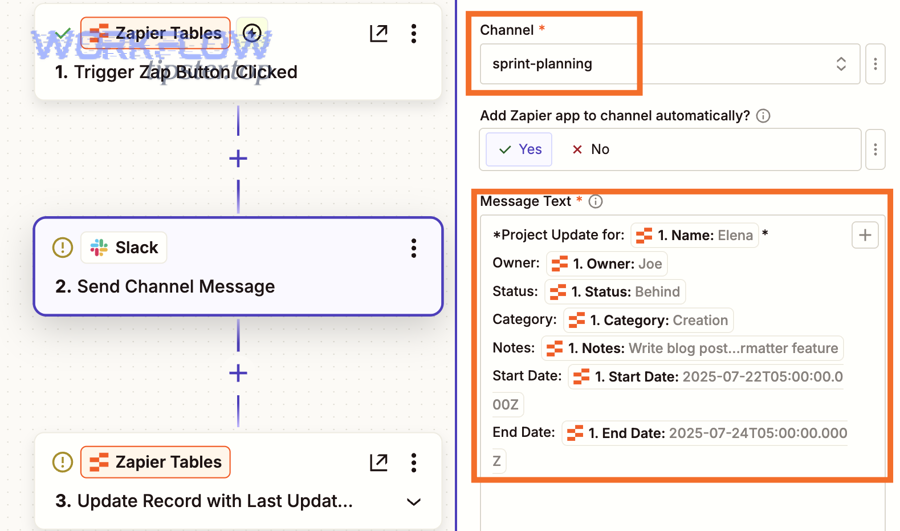
Yes—Google Docs to Slack automation can be done without coding because you can (1) connect accounts through approved apps, (2) choose ready-made triggers/actions, and (3) send structured Slack messages to channels or DMs with consistent templates.
Then, the real question becomes: what level of control do you need, and who needs permission to set it up? A “yes” is helpful only if you can implement it without hitting admin roadblocks.
Do you need admin permissions to connect Google accounts and Slack workspaces?
It depends, but often no—you can connect your Google account and post to Slack as a user if the required apps are already allowed; you usually need admin help when app installation is restricted, org-wide deployment is required, or security policies require approval.
Next, think of permissions as three separate gates:
- Slack app installation gate: Can you add an app to the workspace at all?
- Google account authorization gate: Can you authenticate with the Google account that owns the Docs?
- Slack posting gate: Can the workflow post to the target channel (especially private channels)?
If you’re in a locked-down workspace, you might be allowed to authenticate Google but not install new integrations. In that case, your fastest path is to request the one integration your team will standardize on—because “five different personal automations” becomes an unmaintainable mess.
In Slack’s own setup guidance for the Google Drive integration, the workflow includes adding the app to Slack and authenticating a Google account—plus the note that enterprise org owners/admins can deploy at an org level. (slack.com)
Is it safe to connect Google Docs to Slack via third-party automation tools?
Yes—connecting Google Docs to Slack through third-party automation tools can be safe when you (1) use least-privilege permissions, (2) control who owns the workflow, and (3) regularly review connected accounts and what data the workflow can access.
More specifically, “safe” here means operationally and governance-wise safe. A practical safety checklist looks like this:
- Use the minimum scope needed to detect Doc events and post a message.
- Separate personal and team workflows: team workflows should be owned by a team account, not an employee who might leave.
- Avoid dumping content: in most cases, your Slack message should include the Doc title + link + next step—not the full document text.
- Review channel targets: posting to a public channel is different from posting to a private channel with sensitive topics.
On the other hand, if your organization has strict compliance requirements, a native integration (or an approved platform) is often preferable because it reduces the number of vendors involved.
Which methods can connect Google Docs to Slack for sharing and notifications?
There are 3 main methods to connect Google Docs to Slack—native app sharing, no-code automation platforms, and custom workflow automation—based on your need for simplicity, control, and multi-step routing.
Next, choosing the right method is the difference between “a helpful automation that disappears into the background” and “a fragile setup that breaks every month.”
What can the native Google Drive app in Slack do (and what can’t it do)?
The native approach wins for fast sharing and previews, while automation platforms win for event-based notifications and routing, and custom workflows win for deep logic and governance.
Specifically, the native Google Drive app inside Slack is built for day-to-day sharing:
- Share a Drive link in Slack and get a preview.
- Create/share files from Slack in some setups.
- Keep “Docs in conversation” without building an entire workflow.
However, what it typically can’t do (or doesn’t do well) is multi-step workflow logic—like “only notify #design-review if the Doc is in the Design folder AND the status label is Review AND the owner is in Team A.” That’s where automation platforms and workflow tools become valuable.
If your primary pain is manual copy-paste and “where’s the link,” the native approach can solve most of the problem quickly. If your pain is “we miss updates” or “the wrong people get pinged,” you’ll want automation logic.
When should you use an automation platform like Zapier, Make, or n8n?
You should use an automation platform when you need event triggers, filters, multi-step routing, or structured messages that turn a Doc update into a clear team action.
Then, match the platform style to your team’s reality:
- Fastest to launch: choose a platform with templates, simple triggers, and quick testing.
- Most flexible routing: choose a builder that supports branching logic, conditions, and multi-step chains.
- Most control: choose a workflow tool you can self-host or govern tightly if needed.
A simple example is “New doc in a folder → post to Slack channel with title + link.” That’s a common template-style automation.
And once you’re thinking in workflows, you’ll notice the pattern repeats across “Automation Integrations” beyond Docs and Slack—like google docs to harvest for time tracking updates, asana to gitlab for engineering handoffs, or google docs to mailchimp when content approvals are ready for campaign build-out.
How do you set up Google Docs → Slack sharing so teammates can open the Doc immediately?
The best setup method is a 4-step connection—connect the approved integration, authenticate the correct Google account, choose the Slack destination, and test the Doc link with a non-owner user—so sharing works instantly without “request access” friction.
Next, the key idea is this: a Slack message is only valuable if it leads to an openable Doc in one click, not a permission form.
What is the best way to prevent “Access denied” when a Doc link is posted in Slack?
The best way is to align permissions before automation: share Docs to the correct group/audience by default, keep ownership consistent, and test access using a teammate account that is not the Doc creator.
Specifically, you prevent “access denied” by designing a permission model that matches your Slack audience:
- If the Slack channel is team-wide, the Doc should be shared to the team group (view or comment) by default.
- If the Slack channel is cross-functional, the Doc should be shared to the cross-functional group—or routed to a smaller audience with a request step.
- If the Doc lives in a shared location (like a shared drive), ensure the workflow owner account has access to that location.
A practical rule is: the automation owner must have stable access, and the recipients must have intended access. If either side fails, the workflow creates frustration instead of speed.
Also, verify that your Slack environment supports previews and the team hasn’t disabled them; Slack describes how link previews appear and can be turned on/off in preferences. (slack.com)
Which Slack destination works best: channel, private channel, or DM?
A public channel is best for visibility and searchability, a private channel is best for restricted discussions, and a DM is best for personal tasks and low-noise reminders.
Then, you pick the destination based on the outcome you want:
- Choose a channel when the Doc is a shared artifact (weekly plan, meeting notes, spec draft) and the discussion should be discoverable.
- Choose a private channel when the Doc is sensitive and you can guarantee every member should have access.
- Choose a DM when the Doc update is a personal action (review request, your task, your approval) and broadcasting would create noise.
For busy teams, a strong default is: channel for “team artifacts,” DM for “assigned actions,” private channel only when governance requires it.
What are the most useful “busy team” workflows to automate from Google Docs to Slack?
There are 5 high-value workflow types—new Doc alerts, update summaries, comment/review prompts, approval routing, and publish-ready signals—based on whether your team needs visibility, accountability, or momentum.
Next, the fastest way to make automation feel valuable is to start with workflows that answer one question immediately: “What should I do next—and where is the Doc?”

Which “notification triggers” should you use (new doc, updated doc, comment added, status changed)?
There are 4 main trigger types you should use—new Doc created, Doc updated, comment/review activity, and status/label change—based on whether the event signals new work, changed work, discussion needed, or decision needed.
Then, treat triggers as “signals,” not “events.” Busy teams don’t need every micro-change; they need the changes that cause action. Use this trigger framework:
- New Doc created (visibility trigger)
Use when a Doc is the start of a workflow—new spec, new meeting notes, new draft.
Best output: “New Doc created: Title + owner + why it matters + link.” - Doc updated (progress trigger)
Use when updates indicate meaningful progress—like updates to a controlled folder (e.g., /Specs/).
Best output: “Doc updated: Title + summary + what changed + link.” - Comment added / mentions (collaboration trigger)
Use when comments represent a request—review needed, question asked, decision needed.
Best output: “Review requested: Title + who needs to respond + link to section.” - Status or label changed (decision trigger)
Use when a Doc becomes “Ready for review,” “Approved,” or “Published.”
Best output: “Status changed to Approved: Title + next action + link.”
How do you design a Slack message so it’s actionable (not just informational)?
An actionable Slack message is a short template that includes the Doc title, purpose, owner, explicit next step, and deadline—so the reader can decide what to do without opening the Doc first.
Next, message design is where “automation” becomes “team alignment.” Use a consistent template so your Slack feed stays scannable:
Recommended Slack message template (copy/paste into your workflow):
- What: Doc title + link
- Why: one-sentence purpose
- Owner: who to contact
- Action: “Review / Comment / Approve / Add notes”
- When: deadline or time window
- Where: channel/thread guidance (“Reply in thread with feedback”)
Here’s an example that stays brief but clear:
- “Review needed: [Doc Title] (link)”
- “Purpose: finalize client proposal outline”
- “Owner: Minh”
- “Action: leave comments on sections 2–3”
- “Deadline: today 4pm”
- “Reply in thread with questions”
This design prevents the most common automation failure: messages that look like noise because they don’t tell anyone what to do.
Which is better: native sharing vs automated notifications for your team?
Native sharing wins for speed and simplicity, automated notifications are best for routing and accountability, and a hybrid approach is optimal for busy teams that need both low friction and high signal.
Then, don’t treat this choice like a tool debate—treat it like a workflow design decision. Your goal is to reduce manual copy-paste while keeping Slack readable.
To make the decision concrete, here is what each approach optimizes:
| Approach | Best for | What you get | What you trade off |
|---|---|---|---|
| Native sharing | Quick collaboration | Fast previews and easy link sharing | Less automation logic and routing control |
| Automated notifications | Process-driven teams | Triggers, filters, structured messages | More setup and maintenance |
| Hybrid | Busy teams at scale | Simple sharing + selective alerts | Requires rules to avoid duplication |
This table matters because most teams don’t need “more automation”—they need the right amount of automation.
When is native sharing the best option (minimal setup, fewer moving parts)?
Yes—native sharing is the best option when you want (1) quick Doc sharing with previews, (2) minimal maintenance, and (3) fewer security and ownership complexities than multi-step automation.
Next, native sharing works best when your primary pain is simple: “We keep forgetting to share the Doc” or “We can’t find the latest link.” In those cases, a standard team habit plus the native integration can deliver big gains:
- Post the Doc link in the relevant channel.
- Use a standard message format (purpose + action).
- Keep decisions in the thread so context stays attached.
And because it has fewer moving parts, it breaks less often. For teams that value reliability over deep routing, that matters more than extra features.
When do automation workflows outperform native sharing (routing, approvals, multi-step processes)?
Yes—automation workflows outperform native sharing when you need (1) rule-based routing, (2) consistent structured messages, and (3) multi-step processes like review requests, approvals, and publish-ready handoffs.
Then, automation becomes valuable when your Docs are part of a broader process:
- Content teams: Draft → Review → Approval → Publish
- Product teams: Spec draft → Feedback → Final sign-off
- Ops teams: Policy update → Acknowledgement → Archive
In these scenarios, “someone posting a link” is unreliable because it depends on memory and timing. Automation makes the workflow behave the same way every time.
This is also where cross-integration thinking becomes powerful. If you already build Automation Integrations across your stack—like google docs to harvest for logging time from approved documents, asana to gitlab to connect planning to delivery, or google docs to mailchimp when a campaign brief is approved—then Docs → Slack is simply one link in a larger operational chain.
How do you manage permissions and governance when automating Google Docs to Slack?
Managing permissions and governance means you control who can access the Doc, who owns the automation, and where Slack messages can be posted—so automation increases speed without accidentally widening access or flooding channels.
Next, governance is what makes automation sustainable. Without it, the workflow “works” for a week and then collapses under access errors, ownership changes, or notification fatigue.
What permission model prevents broken links while keeping Docs private by default?
A group-based permission model is the best balance: keep Docs private by default, share them to the correct team group (viewer/commenter/editor), and route Slack messages only to channels that match that group’s audience.
Then, compare the common permission models by what they optimize:
- “Anyone with the link”: minimizes friction, but increases risk (especially if Slack channels include guests).
- “Domain-only access”: good for internal organizations, but still too broad for sensitive Docs.
- “Group-based sharing”: best for teams because it’s explicit and consistent.
- “Individual invites”: secure but high-maintenance, which breaks busy-team speed.
The governance rule that keeps things clean is: the Slack destination should never be broader than the Doc audience. If your Doc is shared only to the design team group, posting it into an all-hands channel is how you create immediate access problems and policy headaches.
How do Shared Drives change Google Docs → Slack automation behavior?
Shared Drives change automation behavior because access is driven by membership and inherited permissions, so the workflow owner account must have Shared Drive access or the automation may fail to detect, preview, or share Docs reliably.
Next, Shared Drives are great for stability—Docs don’t “belong” to a single person—but automation still needs an identity that can see what it’s supposed to monitor. If your workflow watches a folder inside a Shared Drive, the workflow owner must be a member with the correct role, or events won’t fire as expected.
A practical way to avoid surprises is to create an “automation owner” identity that has stable Shared Drive membership, and document that ownership so the workflow doesn’t silently die when someone changes roles.
What are the common privacy pitfalls when posting Docs into Slack channels?
There are 4 common privacy pitfalls: posting sensitive Docs in public channels, forgetting guests exist, triggering previews for unintended audiences, and routing “private-work” updates into general channels—each one expands visibility beyond what the Doc permissions were designed for.
Then, prevent these issues with simple routing rules:
- Sensitive Docs → private channel or DM, not a broad channel.
- External guests in Slack → treat every shared link as potentially visible, even if the Doc itself is restricted.
- Preview content awareness → keep Slack preview settings aligned with your risk tolerance.
- Thread discipline → keep discussion in thread so context doesn’t leak into unrelated channels.
Your goal isn’t to eliminate sharing—it’s to ensure sharing always matches intent.
How do you make automation reliable over time (token expiry, ownership changes, workflow maintenance)?
Reliability comes from 3 habits: assign a stable owner, standardize naming/routing rules, and schedule periodic checks—so token expiry or a team member leaving doesn’t break workflows quietly.
Next, treat automation like infrastructure, not a one-time trick. Use this maintenance routine:
- Ownership: workflows owned by a team identity, not an individual.
- Documentation: a short note describing triggers, destinations, and who to contact.
- Testing: once per month, create a test Doc in the monitored folder and confirm Slack posting.
- Noise review: quarterly, review message volume and refine filters.
According to Slack’s help documentation, installation and account authentication are explicit steps in setting up the Google Drive integration—so reliability depends on keeping those connections healthy over time. (slack.com)